

From Creation to Consciousness: Takeaways from Poor Things
I suspect that most men find themselves in an unenviable position when trying to say anything intelligible or wise about the lives of women. After watching Poor Things, the latest film from Yorgos Lanthimos, starring Emma Stone, I feel no less confident in expressing that sentiment.
Poor Things is an interesting viewing experience. It’s a story that transports you to the past while simultaneously making you more aware of the present and making you ponder, sometimes solemnly, what the future will be like. It’s easy and tempting to say the film deals with issues that exist between women and men, but really it disabuses the audience of this notion. There really are no issues between women and men in the world of Poor Things. There are men with issues who, for lack of awareness, raise hell and wreak havoc on the lives of women.
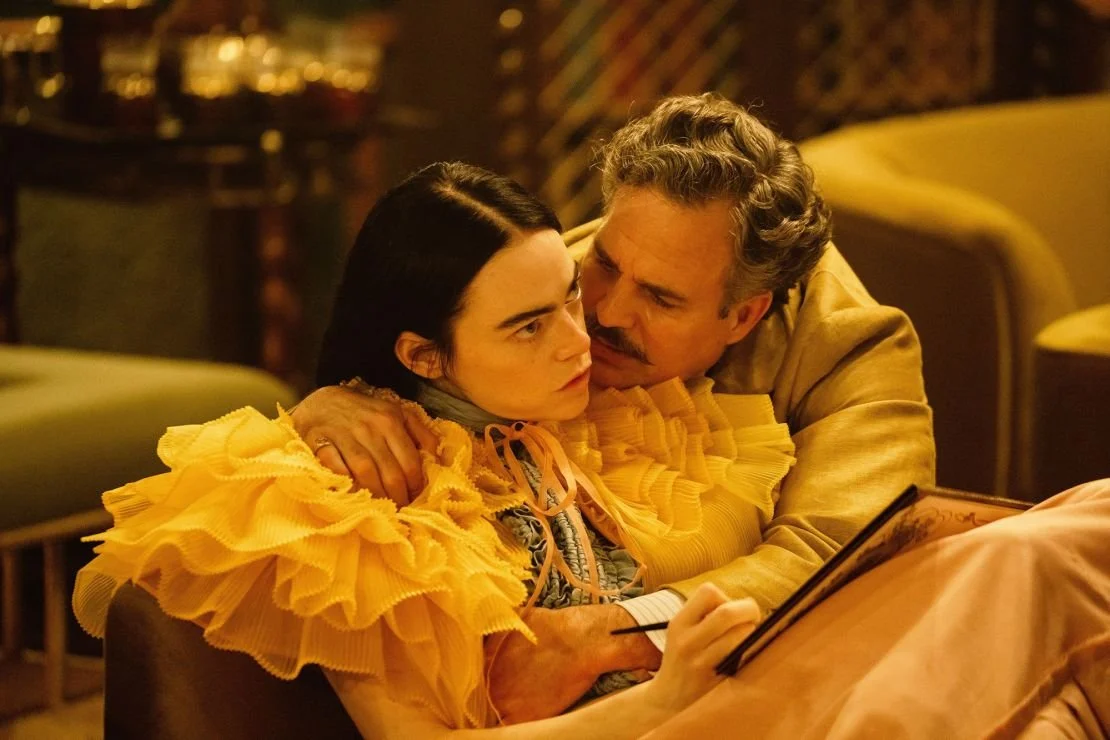
The film quickly establishes the setting as one where women are objectified and lack the agency of their male counterparts. In the beginning, the main character Bella is treated less like a person than she is a psychological mirror for the men in the film who project their own thoughts and feelings onto her. For most of these men the content of their projections never rises above the level of their base desire. Bella’s cognitive shortcomings are easily overlooked by them because they are only concerned with her physical features. Their entire view of her is informed by and filtered through the lens of her beauty. A larger point is being made about male-female relations, which are often entered into and kept alive solely by the power of attraction, which moves people in the direction of what they would like to do without forcing them to consider whether or not they should do it.
Known Unknowns
There is an interesting relationship that exists between the characters and truth. They have an ambivalence about it, a selective amnesia that is used to blot out and hide certain parts of themselves and their reality. At one point the character Godwin, speaking about his father says “They pushed the boundaries of what’s known and they paid the price. That’s the only way to live.” This statement essentially summarizes his life philosophy and his view of how people should live, and yet, in several moments throughout the film he shies away from it. He fails to live up to his ideals and when he is confronted by those ideals through Bella who personifies them, he struggles to accept their presence in her.
It’s commonplace for the relationship between a parent and a child to develop like this. Parents somehow think they can instill certain ideas and values in a child without eventually being challenged to live up to them. Bella goes along with this contradiction early on because she has the mind of a child and cannot for one second fathom how Godwin could ever act without her best interest in mind. But as she continues to develop, she challenges him more and forces him to reveal what is hidden behind his paternalism. Godwin has his own desire for control, which he satisfies in part by instilling a sense of fear inside Bella. Watching this manipulation play out, it’s impossible not to think of other people like him, who twist and contort their own minds until they are able to believe that a human being is somehow something less than that. Godwin accomplished this by labeling Bella as an experiment, but all he really accomplishes is the recapitulation of his own experience with his father who also deemed scientific progress to be the most important thing.
Unfinished Business
The film goes through the trouble of hinting at Godwin’s past relationship with his father multiple times to show that he is still anchored to it and his inability to be honest about that makes it difficult for him to be honest about anything else. His stated goal is scientific progress but really, his existence has become a matter of running from the past and everything else about his life converges on that fact. So much so that he lies to Bella instead of telling her the truth about her backstory and lies to himself about his reasons for doing so. He denies the fact that his relationship with Bella is about more than his morbid scientific curiosity, and eventually he admits that his bond with Bella satisfies what he suspects is a parental urge in him.
What’s interesting is that in order for Godwin to wrestle with his own experience of family he had to recreate it, except this time he served as a stand-in for his father. He had to become him in order to make sense of him and the things he did. The crux of the issue is that Godwin, for various reasons, wants to control his environment and Bella, for reasons of her own, wants to be free. She tells him “You love me too tight.” Which is exactly what it feels like when you are trying to separate from someone you love so that you can find your own identity.
Discovering the Self
Separation is never an easy task. Alexis Carrel said that “Man cannot remake himself without suffering for he is both the marble and the sculptor,” which is why redefining yourself and your relationships is nearly always done in dramatic fashion. For Bella, the force that compelled her to seek separation was pleasure. The discovery of which represented a seminal moment in her growth and development. To her mind she’s found the secret of life, and she not only wants to indulge it but share it with others, and she’s disappointed when she’s reprimanded by the lady of the house for doing so. From Godwin she receives nothing but silence, and her response was typical and no different than that of any young adolescent mind faced with this situation. She ran off with the first person willing to indulge her interest.
This escape marked the next and most exciting phase of her adventuring and for a brief period of time she was able to experience pleasure without consequence or consideration, but this was short-lived. What she came to find after the initial thrill of her escape was that golden, gilded, ornate cages are still tools of bondage, no matter how pretty and exciting. A different type of confinement is all her companion has to offer.
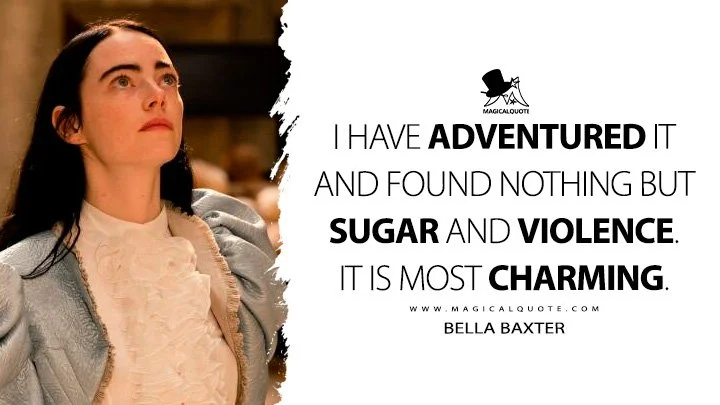
She indulges, but after a period of time Bella begins to realize there are limits to what pleasure and even freedom can provide to an individual. Her seeking and adventuring made her blind to the reality of others and their suffering, the realization of which mortifies her. She is overwhelmed momentarily but then she is energized by her feelings, and able to find another side of life worth exploring. The pleasures of the flesh subside and are replaced by the pleasures of the mind. She’s fascinated by ideas and starts to wonder about the world and her place in it.
Down &Out & Happy
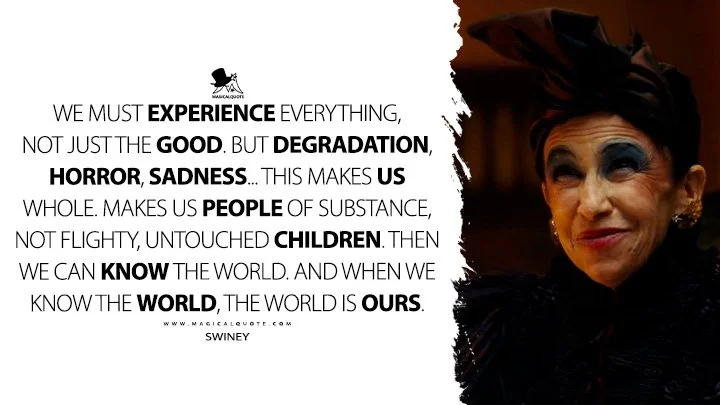
The film is Kafkaesque in the sense that instead of helping Bella to rise up from her sunken state, she has to go even further down to find her way out. What’s interesting and important and difficult for us to understand about the character of Bella is that she embraces her descent with a sense of amusement. For her, difficulties shouldn’t be avoided because they are also opportunities. She views difficulties as the fertile ground on which she can further explore the possibilities of her existence. With this attitude, even time spent in a brothel is informative. Her time there allows her to continue to learn and receive an education that is more empirical, one based on the lived experience of others and her own. She is made to see that sadness and dysfunction make us whole beings, and wanting to be happy all the time is a childish state. Acceptance of suffering, and not avoidance of it, is what leads to the overcoming of it.
Going Back Home
With this understanding, Bella returns home to find out the truth about her origins. She confronts Godwin and in doing so is able to achieve something better than the separation she originally intended. She becomes an individual in her own right, capable of honoring the story she is living and creating about herself, while preserving the parts of her relationship with Godwin that are still important. Her example may be what makes it possible for Godwin to do the same. He is finally able to renounce and break the fantasy bond that he has with his father, and by doing so, is able to be present in his relationship with Bella. He can experience his world with wonder and curiosity instead of trying to control every aspect of it.
For Bella, it wasn’t until she resolved the issues with her father that she was able to establish a mature loving relationship with someone else. One that encompassed union and desire while preserving her freedom and individuality. What I appreciate about the film is that it doesn’t simplify Bella’s bliss. This new loving relationship isn’t an end, but a precursor to her greatest confrontation with the past. The order of these events speaks to the psychological truth that love does heal, but often not until it has brought us face to face with our demons.
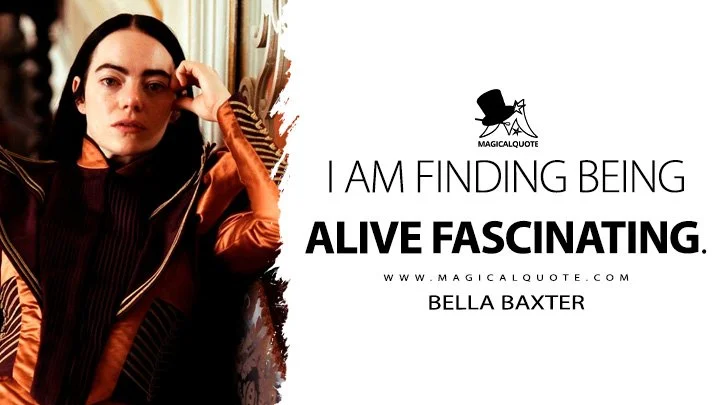
Bella achieves her victory over the past, and most importantly she does so with integrity. She remains curious and hopeful throughout the film. At the end of her journey, having arrived at the place that she is in, she is able to say “I am never happier than when I’m here.” She has made important discoveries along the way about what really brings her happiness, meaning, and purpose.

Identity, Control, and Rebellion: Takeaways from They Cloned Tyrone
Tupac is alive, Michael Jackson ain’t dead, and Toni Morrison might just as well be sitting at a coffee shop nodding, I told you to everyone that passes by. Her presence certainly seems to loom large over They Cloned Tyrone, where you very quickly learn that almost no proclamation is unworthy of consideration, if only for an infinitesimal amount of time.
She, Morrison, articulated the searing effect the white gaze has on black life, giving voice to something that for centuries was a constant, but was so potent and lethal that it was unspeakable. Here it is, recaptured in the film’s opening image of an advertisement with a white man grinning obscenely, overlooking a group of black people having this very debate (about Tupac and Michael Jackson). It sets the stage for the inevitable clash between history and perception, ready to play out in the fictional neighborhood called The Glen.
With art, oftentimes one must at least wonder, if not ask who is the audience, or to put it another way, who did the artist have in mind when they made this? It is assumed, pejoratively, that black movies are made for black audiences and that there is no category called white movies. Movies like Oppenheimer are less impressive to me for the technical feats they accomplish than their ability to craft a historical narrative about post World War II America and what follows that is somehow completely devoid of black people. But alas, it is a movie, made for the movie going audience. Black movies must exist for the supplication of some other category of people.
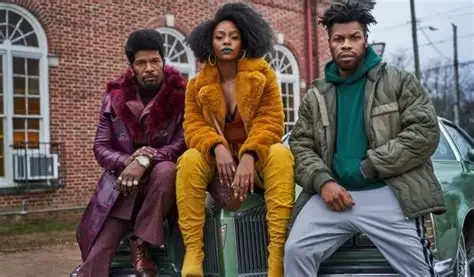
This particular film (Tyrone) offers commentary on the issue of whether or not things naturally are the way they are, or if they were made to be that way, and swallows up the entire category of living with its questioning. It drops you into the lives of its characters and instead of asking you to wonder why they are like this, which is less of an honest question than it is a silent judgement, it forces you to consider who really stands to benefit from these people’s lives being this way?
Everyone has their own unique response to the question as the answers are revealed. Fontaine (John Boyega), Slick Charles (Jamie Foxx), and Yo-Yo (Teyonah Parris) cycle between moments of doubt, denial, and defiance towards their encroaching reality as they take stock of how complex the machinery of what is happening to them really is.
What it means to have a self, and whether that self is a creation, or the by-product of circumstances is another central theme. Does it even matter, is what the film seems to be asking, because in the end, the self may only be a set of ideas, yours, or mine, made to fit together and promulgated through the body. The trailer and title make it known that clones play a part in the film, in the literal and metaphorical sense. Fontaine discovers he has been cloned, but even before this physical manifestation is shown, the ideas that he embodies appear to be nothing more than the repackaged ideas of someone else, which seems to be true for most of the people surviving in The Glen.
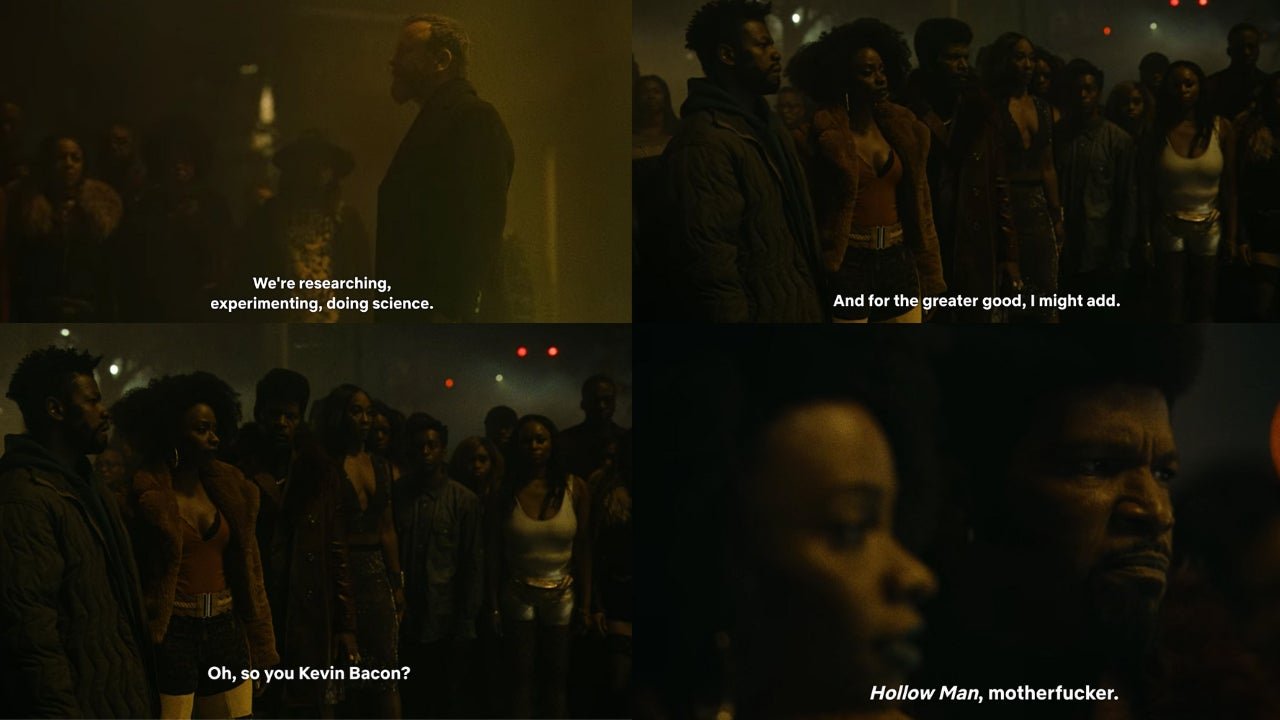
In this way, trauma becomes a common occurrence, and writ large, the private theater of the mind becomes a communal hive. Characters wrestle with what has happened to them and the burden of their nearly forgotten possibilities. Whether one becomes a hero, or a villain seems to hinge on the manner in which they resolve these issues.
Some people never recover from the loss of innocence. One death in particular crystallizes this, but regardless, most characters seem to have had to give birth to an identity much too soon and are thus forced to cling fiercely to it given their vulnerability. Parents are conspicuously absent, and everyone must become their own mother or father much too soon with far too little guidance. Perhaps this is part of the message—parents are, after all, are one step closer to being elders, who function as the collective memory of a community. Memory is a form of safekeeping, without which any group of people is rendered unable to remember the brilliance and tragedy of their history, and thus makes themselves vulnerable to the most wicked ignorance. This is personified by a character whose life is a reminder of what happens when your entire history, past and future, is overshadowed by your worst experience.
The women in the film are the ones who display the courage and intelligence to fight back and injure the cycle that is harming so many, and perhaps break it entirely. They seem to never lose sight of who exactly this is for, and thankfully the film spares them from the fate of being cast as nothing more than accessories to the salvation of men. Yo-Yo dares to dream despite conditions that threaten to suffocate her very existence.
The story is entertaining and even heroic in some moments and fails only if neat and clean resolution is what one seeks, which is certainly forgivable, and fitting given the nature of what it deals with. A quest to discover one’s identity, in this instance, benefits from the inclusion of clones and science fiction but would be no less perplexing without them.

Eight Shades of Hate: Takeaways from The Hateful Eight
Watching the The Hateful Eight, Quentin Tarantino’s latest film, I found myself arrested by the force with which the story was told. Hateful Eight centers on the relationships between eight people, known for and connected by their prior reputations more than anything else. On its surface, the film is about bounty hunter John Ruth’s mission to complete another successful hunt, but the actual meaning of the film is more complex.
The specter of race looms large in it, and Tarantino addresses the issue by setting the film only a few years after the events of the American Civil War. The ghost of that war hovers over and haunts the characters in the film, and apparently still haunt us today—a recent mass shooting at a church in Charleston, South Carolina testifies to the fact. Making a movie set in the late 1800’s both timely and appropriate. Samuel L. Jackson plays Major Marquis Warren, a decorated army veteran who is now himself a renowned bounty hunter. He is black, and the other characters are indignant over having to deal with his presence. To my mind, Warren represents the coming of a new negro, a phrase later taken up during the Harlem Renaissance which symbolized the kind of black person who outspoken in their refusal to accept the indignities of American society.
The encounter that plays out frightful and electrifying, but first there is a series of half-hearted attempts from the other characters to restrain their hostility towards Warren, mostly owed to his reputation as a man highly capable of killing. Tarantino writes Warren as a character whose intellectual prowess is subtly displayed, skillfully employed, and certainly surpasses his physical skills. This quality is established early on and reinforced throughout the film, not by making Warren appear superhuman, but by highlighting the other character’s failure to recognize him as human at all.
As could be expected from this director given his past proclivity, The Hateful Eight is littered with the N-word. Though it used often, the word feels less out of place in this film than it does in other films like Django Unchained or Pulp Fiction. The historical setting makes the harsh dialogue plausible, and the acting performances mostly make the use of the word believable. Not excusable, then or now, but believable that the N-word would be used by white men as a sort of power grab, to put Major Warren back in his place, and reassure themselves of their own. In similar fashion, the B-word is frequently directed at Daisy, the only prominent female character in the film, which seemed too illicit less powerful reactions from the audience. Why is this so? Why do we cringe at the on-screen use of the N-word but not the B-word, similarly used to dismiss and dehumanize?
Beyond race and gender, The Hateful Eight is a commentary on the overall idea of identity.
Who exactly is Daisy and what does she mean to this film? Of the prominent characters, her story is the most underdeveloped. She is branded as a ruthless criminal, but we do not know to what extent this is true, and in a film where the relativity of truth is an important theme, this lack of explanation cannot be overlooked. Daisy seems to serve as a vessel for the other characters to act out their own pent-up anger towards women. Some of the characters consider her a devil, while others think her life is worth saving, and each character's belief about her fate doubles as a window into their definition of justice. Is it cold and dispassionate, or is it emotionally tinged?
These ideas about justice are also seen through the ways the characters interact with each other. John Ruth is the easy choice for an example of dispassionate justice, but even he falls short of this ideal. They all do, which may be the point—these American made figures cannot possibly live up to their own moral codes, and when it is a choice between them and the other, such codes are easily abandoned.
Beyond race and gender, The Hateful Eight is a commentary on the overall idea of identity. Flashbacks, and well-crafted dialogues highlight the fluidity of identity, and how quickly it can shift. The characters' behaviors, and perceptions of each other, as well as the viewer’s perception of them, changes at a dizzying pace. This pace does not set a new standard for Tarantino films, but in the past, the frenetic pace left some viewers confused, and others dissatisfied, and it is better executed in The Hateful Eight. By confining most of the film to a single room, Tarantino creates a world that is less open and sprawling, while maintaining his style as a filmmaker. The result is a film that operates well on multiple levels, at once being easy enough to follow, and at the same time complex and layered.
Will the audience understand the message? Will they understand that Tarantino is critiquing race relations in America on multiple levels? I fear that the humorous moments laced throughout the film will provide people with enough justification to gloss over the more serious aspects of the work. Especially people who still today harbor the same hateful attitudes as the film’s titular characters. More than anything, with The Hateful Eight, Quentin Tarantino deftly shrinks down a significant piece of the American experiment and places it into one room, serving as a metaphorical melting pot. He captures all the madness that is produced as result of this experiment called America, and the taste of redemption we get when this experiment functions as intended, however short and fleeting those moments may be.