

AI and Human Responsibility
As we move further into a world in which artificial intelligence is a part of everyday life, we must consider the psychological effects this technology is having on us individually and collectively. We have to keep asking ourselves what we want this technology to be, how we want to shape it and how we are willing to be shaped by it.
There is a fight going on currently between the United States government and Anthropic, one of the major AI tech companies. Though the debate centers on the government's ability to use Anthropics AI technology in its military operations, the outcome of this fight will have major implications for the relationship between humanity and artificial intelligence.
There is a contingency within the government that wants to fast-track the implementation of AI into military operations. This contingency, made up of government officials and military officers, view AI as a way to more effectively deliver violence. Such thinking reveals an underlying belief in the inevitability of violence, and perhaps in their mind, the worthwhileness of violence as an objective.
The military, like other organizations grappling with AI, must give significant thought to the potential human cost of developing AI without regard for the psychological effects this technology is having on individuals and communities. Some people think AI is dangerous, and this view may be justified as there does appear to be a dark and destructive vision of AI forming in some segments of the government. Military officials who support this vision view AI as a tool that can enhance and augment the ability to inflict mass destruction without being hampered by ideological constraints.
I’m struck by that phrasing—without ideological constraints—struck by how disingenuous they are. Ideologies are simply systems of ideas, they are a specific manner of thinking, and even the most vague and ill-defined patterns of thought can represent some form of them.
The dream of an AI that allows someone to operate without ideological constraint is a contradiction that doubles as an admission of a specific kind of ideology, one whose guiding principle is action without inhibition. If used in this way, AI will become a tool that further cements a pattern of relating amongst groups that hinges on their being a dominant and a subordinate party. This inevitably leads to more conflict and turns any notion of AI being able to usher in a new era of prosperity and flourishing into nothing more than a clever marketing ploy.
When it comes to the debate over the use of AI in the military, two camps seem to be emerging, which I will respectively call the functionalists and the aggressionists.
Functionalists seem to advocate for AI that can reduce the cognitive load placed on military servicemen so that they can focus on tasks that are more central to their missions. Functionalists believe that human operators should still be the ones making crucial decisions.
Aggressionists share some of the same goals as the functionalists, but they are also more bold in their ambitions. This group is more likely to view the development of AI as a new Manhattan Project. Beyond improved functionality, what they are most concerned about is winning what they believe is the new global arms race, with AI as the deciding factor.
Thus far the aggressionist viewpoint seems to be winning out. The powers of the judiciary are currently being turned on Anthropic and used as leverage in their dispute with the government. Vague and innocuous phrases like “supply chain risk” are being used to brand Anthropic as a serious threat to national security. It is difficult to make the CEO of a multi-billion dollar corporation into a sympathetic figure, but that’s the point we’ve somehow arrived at in this saga.
The view that unfettered access to AI is crucial to military success is complicated by the fact that success is being defined as the ability to create lethal effects at scale. We should all be leery of following such logic.
AI should be developed in ways that serve the interests of humanity and produce the most positive good. Such outcomes are only possible if we advance beyond narrowly thinking about AI only in terms of military power.

Unraveling: Rage & Loss in Louisiana
A third of the year has gone by. Spring is here and soon we’ll be moving towards Summer. We’ll be looking forward to vacations, barbecues, swimming pools, family gatherings, but we’ll also be privy to a violence that seems to follow along with the heat and encroach upon us. These warmer months seem to make us yearn for release, and sometimes in letting go we lose control in the most tragic and consequential ways. A third of the year has gone by—there’s more sunlight and heat, but this week we are also left shuddering at the violence that overtook a sleepy little town in Louisiana called Shreveport. One where the community is left to grapple with the deadliest mass shooting in two years. A rampage that resulted in the death of eight children.
People can be insensitive in how they go about satisfying their constant wish to be entertained, but as desensitized as we sometimes are, the thought of children losing their lives is still unsettling to us. It is one of the few tragedies capable of transforming our collective appetite for entertainment fodder into collective shock and grief.
A Mind in Decline
The facts as they have been reported indicate that all of this destruction stemmed from a dissolution, a conflict or conflicts that could not be resolved and resulted in the ending of a relationship. I doubt we will ever be free of such things, lover’s quarrels and all the stress and pain that they engender, but I do know that no quarrel between lovers should ever end in murder. Most don’t, but most still leaves far too many occurrences.
I want to consider Shamar Elkins, the man who perpetrated this, not to cover him in compassion or excuse his sins—I have no interest in that, and not to flatten and erase him with narrow opinions of who he was and what he did, but to understand what he represents.
There was at least some self-awareness of the fact that he was struggling mentally. He checked himself into a facility in January. Maybe he received a modicum of care, but most mental health hospitals are only designed for short-term treatment and immediate stabilization of symptoms. They are not designed for long-term treatment with the goal of helping patients engage in meaningful depth-based psychological work that is necessary to address deeper psychological problems and improve mental health outcomes.
Like most people in those situations, Elkins was granted a short reprieve from the stressors of his life before having to return to them and was ill-equipped to handle them. It’s likely that some of these stressors were self-created, but there is still something crushing about reaching out to ask for help only to be brought back to the same problems and insurmountable consequences that brought you low in the first place. This is especially the case for men who are loath to humble themselves and admit that they are struggling.
Shortly thereafter, like many other men in these situations, Elkins seems to have abandoned the idea of ever being helped again by another person. His reaching out became public pleas for God to guard his mind and help him reject “depression, anger, anxiety, and panic.” There is an arrogance also hidden inside of the humility that allows one to rely on their faith for assistance—one that covertly expresses the belief that only a divine source is capable of helping me, not another human being. Neither arrogance or divinity prevented Elkins from trying to kill himself in February, and shortly thereafter, threatening his wife that he would try again to kill himself and their entire family if she followed through with her attempt to leave him.
There were signs that something bad could happen, but it is difficult to believe that it could ever come to this. His descent is hard to fathom, but we know now that he was clearly a man who was spiraling out of control. A week of mental health care might have forestalled the outcome, but it was not sufficient enough to prevent it. To get and stay mentally healthy requires maintenance and upkeep, otherwise we are all vulnerable to dysfunction, especially during the most difficult seasons of our lives.
The Cost
The most egregious aspect of all of this is the fact that children’s lives were either lost or changed forever. Eight children were taken. Only a 12-year old child escaped, and I wonder what exactly did she escape to? Certainly not to safety. Her life is forever altered by these events, and the fight to reclaim some level of peace and stability will be long and arduous.
“I’ve lost eight parts of me.”
That’s what Troy Brown, the father of the lone surviving child had to say about the rest of those “precious babies” he helped take care of, the ones who are now gone away.
It is difficult to understand the kind of rage that drives a man to snuff out innocence, but we know that it must be dark and cruel and terrible. It must exist outside the confines of human decency and it must be just as abhorrent as it is vicious.
Louisiana is as much my ancestral home as any other place will ever be. I know it by its contradictions—it is a place defined by its longing and its fullness, its excess and its impoverishment. A place with the best food, the nicest people, and the prettiest women, where de facto segregation still exists, where power is still hoarded, and poverty is still an institution. I am reminded on weeks like this just how unsettling it can be—the combination of all this beauty and terror.
The Governor categorized Elkin’s acts as evil, which is undoubtedly how many people feel, but once again my concern is that doing so flattens and reduces him. It absolves him and our society which produced him of responsibility. To label him as evil forces us to beg the question, how could we expect anything else from evil incarnate?
Sophia Nelson phrased it better when talking about a similar tragic event that occurred recently. “Domestic violence can occur in any family in any place.” She’s highlighting the fact that domestic violence is a social problem that is endemic, not an isolated act of evil.
If there is something that is befitting of that designation, it is the all too common belief that a relationship implies ownership. It is only within that framework, that men are able to justify and be excused for denigrating, dominating, and killing women, all in the name of keeping their entitlements.
It’s notable that while much has been said about the kind of mother Elkin’s partner was—caring, doting, loving—very little has been said about who she was as a wife. Even without that history, it’s already clear that whatever her virtues or shortcomings, none of them warranted her and her children being executed. If anything, the silence on the matter is another indictment of the many among us who upon hearing about such incidents first respond by asking, well, what did she do?
Maybe Shamar Elkins was overcome by some kind of emotional torment, some kind of temporary insanity, but it's clear he was also fueled by something else. A hatred, a sickness, a malice towards women that made him believe that he was entitled to take what was not his.
Something broke inside of him, little by little, and then all at once, or maybe nothing broke at all and whatever was inside of him was simply revealed. He could not face it so he fled from it instead and now we must, in the absence of the wicked and the innocent, carry this burden, always and forever.

From Court to Couch: What the Luka Dončić Trade Teaches Us About Group Dynamics
As a preface to what I’m writing about now and hopefully in the future, I’ll briefly speak about the origins of my love for basketball. My earliest and most vivid memories of the sport are watching the 2001 NBA Finals between the Los Angeles Lakers and the Philadelphia 76ers. Without really understanding anything about basketball, I was still entranced by the competitiveness and aerial acrobatics that were being put on display. That was the start of me harboring dreams of becoming a professional athlete. Dreams which did not come to fruition, but birthed in me a love for the sport, and sport in general, ever since then.
I’m a therapist, not a professional athlete, and I cannot help but to blend these two facts of my experience, to examine sports through the psychological lens of my profession and perhaps share the combination of these two things through my writing.
A transaction took place between two sports teams last week that by most accounts is viewed as the biggest trade in the history of the NBA, if not the history of professional sports. The Dallas Mavericks traded their start player, Luka Dončić, to the Los Angeles Lakers in exchange for one of their star players, Anthony Davis.
Other details were involved but that was the headline, and rightfully so. Decisions involving someone who is considered to be one of the best in the world at their sport do tend to reverberate across multiple channels. The media coverage has been extensive and warranted, and rather than rehash what has already been said, or focus on individuals alone. I want to examine what happened from a group context in order to highlight the other characters involved and understand the situation from a different perspective.
Why Was Luka Doncic Traded?
The decision to invite a new person into a group or to kick someone out of a group is not made on impulse alone. There may not be an abundance of forethought, but there is at least some consideration given to this decision before it is made. The feeling of wanting to make a change is present in the group before it is ever given verbal expression. It is a process in and of itself for a group to accept and acknowledge the presence of hostile feelings towards one of its members and the possible implications of allowing those feelings to surface in the group. Typically the group allows (or elects) one person in the group to take on the task of being the first person to verbalize their feelings. It is only after this that the rest of the group members can openly respond to the hostile feelings which have been present.
The Mavericks seem to have made their first acknowledgement of their hostile feelings towards Dončić sometime in January. They did so in the form of a hypothetical question, a soft lob thrown in the direction of the Los Angeles Lakers. Well, would you trade for Luka Dončić? As is the case in groups, strong sentiments are initially shared in a manner that hides the depth of feelings behind them. Hypotheticals often hide the reality of strong desires.
Reasons for the trade have been discussed ad nauseam. Dončić drank and ate too much and worked out too little. He was temperamental and by their estimation, too expensive. I’m not particularly interested in any of that. My interest is in examining the privileged position Dončić had within the Mavericks organization (their figurative group), how he came to occupy it, and the reasons his position changed so drastically.
On the face of it the answer is simple. Dončić is a phenom and the culture of the NBA is that players of his caliber are empowered almost immediately. Because they are exceptional, organizations quickly become beholden to them. Every NBA team is a group with established norms and ways of functioning.
Drafting a player is tantamount to inviting a new person into the group. In most cases the new member must quickly adjust to the rules of the group, but in the case of Dončić, who was so unique, he did not have to make the same adjustment. When someone who enters the group is viewed this way, the group responds by changing to fit the needs of the individual. There is an immediate shift in power within the group.
This shift represents the renegotiation of a new agreement amongst the members of the group. Under these circumstances the new agreement is essentially this: the group will give up its individual and collective power in exchange for the benefits the individual can provide. In sports, teams give up control to star players because they believe their individual performance will result in organizational success. Such is the case with the Mavericks, who believed Dončić was the key to future success.
Or at least they did. The first domino to fall, which led to this sequence of events, was the Mavericks losing their belief in Dončić. Ironically it was their success, not their failure, that led to this conclusion.
The Mavericks have been criticized for trading away a player who led them to the NBA finals just last season. This is taken as proof of Dončić’s ability to eventually lead a team to a championship. But the Mavericks view it as proof positive of the exact opposite. Their loss to the Celtics in the NBA finals did two things. It showed the Mavericks they were good enough to get to the Finals but nowhere near good enough to win a championship. Secondly, it removed the spectre of hope from the Mavericks. Not completely, but resoundingly enough to cause some people to lose faith in Dončić, the person who had been given so much power within the group.
The Underlying Power Dynamics
General managers of sports teams at times function like group therapists. They are responsible for looking after the safety and well-being of the group members and ensuring the group is functioning well as a whole. Managers do not act alone and operate within the structure created by ownership, whose presence also impacts the group even if they are not explicitly a part of it. My view is that Nico Harrison, the Mavericks general manager, acted freely in deciding to trade Dončić, but his actions were not free from outside influence.
Harrison, as is typical of people in his position, was chosen by the group to carry out their wishes. A lot of time has been spent trying to understand exactly whose wishes Harrison was carrying out, but this hard to know because there appears to have been factions or subgroups within the Mavericks organization. These subgroups exist within the Mavericks organization and the larger group that is the NBA and can be identified by the way they responded to the trade. These groups can be divided into players, management, and ownership. Each groups response reveals something about their competing agendas, all of which impact the group dynamics.
The player’s response has mostly been a negative one. They were shocked by what occurred, protesting the unfairness of it, pondered what it meant for them, and quickly came to the conclusion that it meant no player was safe.
Groups will sometimes elect one of their members to play the role of scapegoat, to take the blame for the group’s lack of progress. As the pressure builds, the scapegoat is eventually expelled from the group. Their may be a momentary feeling of relief now that the problem is gone, but relief is followed by fear and panic.
This happens because on a deeper level members are aware that the problems of the group are always about more than one individual, and will persist even after the individual is gone. They know that if someone like Dončić can be scapegoated and unceremoniously traded, the same could also happen to them. The group trembles at this realization, and the part they played in bringing it about.
The common response from players is to think about the personal impact trades have on them. Management, acting as de facto group leaders, must respond by trying to help the group adjust to this change and restore group cohesion. Harrison has done this by trying to instill hope and outlining a positive vision of the future of his group, His belief is that the group will function better now and is better positioned to accomplish their ultimate goal, winning a championship.
This is the appropriate response, but it is not always easy to restore group cohesion but doing so can be a challenge. For the Mavericks, they have had to contend with raucous and emotionally charged reaction from their fans, one they likely did not fully anticipate. This highlights another important aspect of group dynamics. While not directly involved, fans, like family and friends of group members, can exert a large amount of influence on group dynamics. Especially when they are activated by something going on within the group.
Ownership could take a supportive stance which could bring clarity or help the group move their discomfort towards acceptance. It seemed like Mavericks ownership would have rather not done that given their initial silence in the aftermath of the announcement. A silence that was broken via an interview that was published over the weekend, and almost certainly was motivated by the fact that fans staging protest in front of the American Airlines Arena where the Mavericks play. They seem to prefer to stay in the background, but this choice along with others they make may be the most significant because they lead to a repetition of the same group dynamics that led the Mavericks to this moment in time.
It has already begun to happen. After the trade a narrative quickly began to emerge about Kyrie Irving now being the leader of the team (group). Over the weekend, after Anthony Davis made his impressive Mavericks debut there was a coalescing around the idea of him being the potential leader of the Mavericks. Another uniquely talented player whose presence once again entices the group into placing their hopes and wishes and power inside of him.
The storm within the Mavericks organization reached its climax with the trade of Luka Dončić and that storm will inevitably come to an end. A new group is forming. They are establishing their own norms and formulating their own agreements, and despite an overall structure that mostly remains the same as it was previously, their is hope that this particular group will take them to new heights.
We shall see.

The Beauty in Brokenness: How Despair Can Illuminate the Path to Healing
What exactly is despair? A state of mind entered into not on account of a person’s own will and volition, and not one that they feel pulled into by a strength greater than their own. Despair is more akin to the person who slumps down defeated after a long struggle. It comes to them when they feel they are at the limit of their capacities, when it feels as if they have reached the final step on the staircase of existence and there is nothing new for them to strive for or experience.
Thankfully, despair, while being quite convincing in this regard, is nothing more than an illusion. Not in the sense that a person doesn’t actually experience the dark and heavy thoughts and feelings that accompany it. Those are as real as it gets. What is not real is the conclusions that are drawn from this experience. Despair is not a final stop or an end to happiness. Despair is a crucible in which everyone, once there, has the opportunity to reach down even further within themselves and discover new strength that they did not know they had. And with the discovery of new strength comes the discovery of new possibilities.
Much of what people discover and attain in the way of progress can only be gained through difficult circumstances. Anyone capable of examining their own life can agree with this sentiment. The path towards being whoever and whatever it is one wants to be contains both difficult and easy moments, but it is the difficult moments that are most impactful and remembered most vividly.
Imagine for a moment, a person named Johnnie who has complained for months about her dislike of doing hard things, and really that word doesn’t describe it–hatred is the most appropriate word to capture her feelings. Week after week she complains about her life and the things she would rather not face, using every method of avoidance she can conjure up in her mind. And the harder she tries to avoid; the more difficult things become for her until eventually there is nothing else she can do to avoid the challenges in her life. As dogged as she has been, she is finally all out of tricks, and with this ending comes the beginning of her own personal encounter with despair.
Despair is not the final stop or the end of happiness. Despair is a crucible in which everyone, once there, has the opportunity to reach down even further within themselves and discover new strength that they did not know they had.
She has been sick–sad, blue, depressed, ill, any and all of those things, but none of them, no matter how terrible, has been enough to make her give up trying to push away her problems. It is only in realizing that one is surrounded and without any more exits that they have the opportunity to be brought into a new psychological state. The transition is difficult. It is a type of pain that has not been experienced before. It is blunt and direct, and aching.
Despite all this discomfort, the therapist must insist that someone like Johnnie turn her attention towards the things she desperately does not want to look at, and the must do so without being abrasive and damaging. They must accept the fact that the best they may be able to manage is to get someone to look at the details of their life for a few minutes at a time, and sometimes even less than that. They must be persistent in their encouragement that a person keep coming back to their situation and try to see it with clarity.
The wish for life to be easy is difficult to give up, and it is equally difficult to be in the position of having to push someone to relinquish it, but it is necessary. The best form of help one person can provide to another is getting them to realize the fact that life is never really easy for anybody, and the only thing left for a person to do once they know this is to embrace the struggle and take the hard road. It’s no easy feat because treading an unfamiliar path inevitably means embarking on a journey without a map in search of somewhere you’ve never been with nothing but the hope within to carry you forward. But, if someone can make the difficult start and keep moving through the treacherous middle, they find that eventually the journey does become less difficult and even though they don’t know exactly where they’re going or what they’re doing, they start to trust that they’ll know when they get there.
…life is never really easy for anybody. And, the only thing left to do once you know this is to embrace the struggle and take the hard road.
Despair can unlock new depths of experience within. I called it a crucible, but it’s just as appropriate to compare it to being locked inside of a mental gymnasium where strengthening your mind is the only way to break free. Anyone who continually expects ease and comfort in life will be perpetually disappointed. They’ll sit on the floor lamenting life’s unfairness while wasting away. This is the falsehood that a misunderstanding of despair leads to, and this is why it is important to realize that even in despair, and in a certain sense, only through despair can a person transform their life.
The person who undergoes this transformation does so by choosing to become stronger, not by waiting for the burdens of their life to become easier.

Turbulent Times: Takeaways from Attending the AGPA Connect 2024 Conference
Things were good, but that wasn’t good enough. Over time I’ve learned that it’s not in my nature to be easily satisfied, a fact that is sometimes as irritating to me as it is to others. I accomplished most of what I had set out to do academically over the last few years. I received applause from the people I expected it to come from. None of it was surprising or particularly exciting, which was the problem. Everything had mostly gone as expected, and rather than feel good about this, more than anything else, I felt painfully bored. I was searching, or at least I wanted to be searching, but I had no idea where to begin, so I was restless and resigned to my circumstances. I felt completely unmoored. I wanted to be standing on the precipice of something different, but it was difficult to know which path would take me in the direction of the difference I was seeking and whether or not I even knew what that was.
Those were the circumstances I faced when I once again was presented with the opportunity to attend AGPA Connect, a conference hosted by the American Group Psychotherapy Association, that I had little interest in attending up until then. By now I had advanced enough in my career to also be swayed by a sense of duty and obligation to attend the conference, and there was also something more to it. The solution to my current predicament, I concluded, was to run towards my boredom, frustration, and career anxieties, and throw myself fully into them. It was counterintuitive to choose to move towards the sources of my discomfort, and that was different enough for me to be convinced that it was worth trying.
Arrival
I flew into Washington D.C late on a Saturday night, and immediately marked myself as a typical Southerner by my lack of preparedness for the change in climate. A year spent living in Pittsburgh had convinced me that my body would get used to it and a light jacket would be enough, but all my northern exposure did was make me foolishly indifferent towards the weather. Standing outside of the airport in cold and windy Washington D.C I quickly realized that I was not prepared for the effect the weather would have on me.
The people seemed nice enough. They were at least willing to humor my questions about where I could find a store to buy proper attire at midnight, but could not provide much in the way of help. Solving that problem would have to wait until later.
I decided I would be using public transportation throughout the week and the man who arrived to bring me to the place where I would be staying was chatty. He described himself as El Salvadorian because of his mother, and Costa Rican because of his father. He was a bad driver, who took multiple wrong turns and drove on the wrong side of the road, but I figured this was the norm for a major city so I said nothing. I rationalized that as far as introductions to a city things could have been worse.
Attending AGPA is like being transported out of time, or at least being transported to a place where time seems to move at a different pace and rhythm, one that is wholly defined by the AGPA calendar instead of any celestial cycle.
Before my flight even landed I was already watching, looking out for what the experience might have to offer. The culture of the South, and maybe every other place, is this odd mixture of familiarity that comforts and suffocates at the same time. I always forget, when I’ve stayed there too long, that not all aspects of culture travel well. Some parts get left behind, and make space for experiencing alternative views of life. Some parts get dragged along no matter how much you might like to leave them behind. Race falls into the latter category.
At some point my Uber driver decided he likes the black people in Washington D.C more than he likes the black people in other places because he gets along better with them. Through some unknown calculus he decided to confide in me, a black man from another place, about his discovery. The irony of the situation was not lost on me. I feigned a few lines of curiosity, as he told me that I should visit Baltimore to be among my people. I nodded as he told me about his wife who he wanted to take on a vacation to Pennsylvania, in part because it was too dangerous to travel back to her home in Colombia. I kept nodding, and when it was time to get out of the car, I thanked him, grabbed my bag, and went inside. It was the type of conversation that made me feel like I was right back at home.
Start of the Conference
Attending AGPA is like being transported out of time, or at least being transported to a place where time seems to move at a different pace and rhythm, one that is wholly defined by the AGPA calendar instead of any celestial cycle. It’s a phenomenon that is difficult to fully grasp, and while trying to wrap my head around it I was also tasked with thinking about a different question, what it means to be an ally.
A room full of new, unfamiliar, delighted faces, and myself, had to ponder this question. We discussed it while discussing ourselves, which is how a lot of learning is done at AGPA, through a mixture of curated topics that have off-ramps into the realm of the personal built into them. This worked for me because it allowed me to gradually open myself up without being pressured to do it all at once, and always gave me the option of taking my foot off the gas and slowing down if I wanted to.
Even though there are built-in stopgaps, most people tend to ignore them, and strong connections develop fast at AGPA. It’s appropriate that the word connect is included in the title of the conference because it’s greatly emphasized. People who attend the conference are chomping at the bit for it. Secretly I was too, and when asked what I wanted from the experience, I talked about looking for a home. A few years ago I thought I had it, but I was searching once more.
Pain and torture breed isolation and people are more likely to find strength and healing if they have a community to rely on. It is the group, and not the individual that survives, and it is within the context of the group that some individuals can begin to thrive.
Seated at dinner that night, in a sectioned off room full of the faces I had met that morning and afternoon was where I had my first inkling of it, when I gave my first real consideration to the idea that I might have found a home. There were plenty of accomplished people in the room with numerous accolades, but it was their warmth and their willingness to share their stories that most affected me.
After dinner a group of us splintered off and found ourselves in the lobby of the hotel bar, drinking, laughing, storytelling, connecting. A woman brought out a deck of tarot cards and each of us drew from the deck, reading the description of the cards we had chosen and its personal relevance to us. Tarot cards had no significant meaning to me until I was in a relationship with someone who liked to use them to predict the outcome of our romance. It might have mitigated her anxieties, but it worsened mine because I never knew what to expect. It was based on the message from the cards, so on some days our love was inevitable, and on others they provided perfect justification for the chaos and turmoil that existed between us.
Obviously my view of tarot cards was slanted towards the negative, and for that reason, this unexpected gathering was more than random entertainment. The entire experience with the cards and these people served as a medium that allowed me to re-do what had been a painful experience and incorporate something new into it. What used to be an unpleasant association became tinged with the sweetness of that evening spent sitting at the lobby bar.
Torture
Early on at the conference it occurred to me that an aspect of my identity that I don’t think much about is nationality. Despite the historically tenuous nature of my relationship to the term, I take for granted the fact that I am an American. Not much thought or consideration is given to this fact unless I am traveling abroad, or in this instance, still stateside but in a more multicultural environment, which Washington D.C certainly is in comparison to Louisiana.
This is one of the reasons I was interested in learning about therapeutic work with forced migrants, a topic I knew nothing about. I’m less ignorant now, slightly. I know about the millions of people from the hundreds of countries around the world who are violently branded with the term migrant. I know, in the most disconnected way possible, what they have had to survive, and now have a more clear vision of how I might help. Now I understand that as a therapist my own clarity of mind is crucial to helping others because ambiguity is more than just an uncomfortable state. It is also a tool used by torturers and oppressors who come from all walks of life. This is what I am tasked with trying to work against. My own inner clarity is crucial for supporting others as they find their own way out of this web of ambiguity and return to life feeling more empowered. This process can take place one person at a time through individual therapy, but it can be accelerated. Pain and torture breed isolation and people are more likely to find strength and healing if they have a community to rely on. It is the group, and not the individual that survives, and it is within the context of the group that some individuals can begin to thrive.
Full Participation
Which is not to say that being in a group is always desirable. It certainly isn’t easy. Everyone brings their own perspective to the experience. Everyone carries inside of them their own world, colored by the presence of others, yet still wholly unique to themselves. And when there is a confrontation between two worlds, the process of convergence can be difficult.
The beauty and terror of being in a group is that it allows you to excavate thoughts and feelings that you hardly knew were there. Through this process new discoveries are made about the self and others, and concepts that seem vague and coolly intellectual become more personal and understandable through a combination of experience and reflection.
I knew enough to know that AGPA would set the stage for this conflict through its Institutes, all day affairs in which I would become a part of a therapy group, not only as a silent observer, but as a full-fledged participant. As the theory goes, this was supposed to help me learn what it means to be a group therapist, and help me incorporate my learning more fully. Despite knowing this, I was still skeptical going into the institute, but that’s the point. New group members feel the same–they are skeptical about how joining a group will help them in any way. They, which is to say I, experience a mix of fear and curiosity about the whole thing, especially being seated amongst professional peers, which makes a person act with some trepidation. The smallest decisions, such as what chair to sit in, become crucially important, and everyone knows it because everyone is trained to notice these subtleties, and the feeling that there really is nowhere to hide is exacerbated. The paradox is that this is true and it isn’t. You can hide, but really you can’t, because even the act of hiding reveals something about you.
Microaggressions
In any social context the specter of microaggressions looms large. The question is to what extent are people prepared to talk about the presence of this phenomenon, and to what extent are they willing to address microaggressions when they occur.
The topic was introduced early on in the group, and the right things were said about microaggressions often being unintentional, but there was something about the discussion that left me unsettled. It was difficult to say at first, but it became clearer over time that there is something about the way microaggressions are discussed as a universal phenomenon that is unsettling to me because it ignores the complex ways in which this process plays out. Microaggressions may be unintentional products of the unconscious, but the unconscious functions differently from person to person, and this functioning is often greatly affected by privilege and power. In addition to this, conscious awareness also plays an important role in microaggressions that cannot be ignored.
The types of microaggressions perceived to be available to a person are a function of identity. It is difficult for me to recall ever having enacted a microaggression against a white man because of the psychological effects of a legacy of racism that makes it clear what boundaries should not be crossed. But it feels much more probable that in my life I have microaggressed against women, even if I can’t recall specific incidents, because of a different power differential that exists in these relationships. All of these thoughts came to me because I was in the group. It is impossible to predict when and if I would have become aware of them in any other way, which I think is the point. The beauty and terror of being in a group is that it allows you to excavate thoughts and feelings that you hardly knew were there. Through this process new discoveries are made about the self and others, and concepts that seem vague and coolly intellectual become more personal and understandable through a combination of experience and reflection.
Desire
My sideways glances kept directing themselves towards a woman with piercing eyes who was seated across from me and my attraction made me realize how much this room was like so many other rooms I had been in. I realized the prevalence of desire, not just at a hotel with thousands of people closely residing next to one another, but everywhere else too, almost all of the time. I bring desire into almost every room I walk into, and it was in Washington D.C that I noticed that it was constantly by my side. At presentations, panel discussions, and dinners. Walking alongside strangers, and waiting for rides. The feeling of desire was ubiquitous, and in this environment, more easily acknowledged.
Years ago I sat through a lecture on the mate selection process, and listened as the professor named desire as a poor barometer by which to judge someone’s viability as a long-term romantic partner. He encouraged the use of other standards when trying to find a mate, and I couldn’t really disagree with his larger point about the limits of desire, a point which ironically is made valid because of the limitless nature of desire. But I couldn’t totally discard desire as a useful tool for relationship building either. The rush of excitement that we experience when we find someone who we desire is often enough motivation to draw us into an interaction with them. This does not always lead to romance, because feelings are not always mutual and even if they are desire is rarely strong enough to triumph over incompatibility, but this is not the only option and sometimes, desire is the starting point of what may become an intimate relationship of real importance. The lesson one learns over time is how to be careful with desire, not to completely disregard it.
Therapy groups illuminate these hidden fears and desires by forging a crucible in which these dynamics can arise without being immediately discharged or casted aside as is the case in normal life. It is inevitable that you will find within the group, whatever exists outside of it. This is a familiar axiom in the world of psychotherapy, the understanding that people bring their experience with them and recreate it in the therapy situation, or at least act in ways that allow the experience to resurface in this context.
The struggle that every therapist must contend with and resolve is where the line between the personal and the professional lies, and whether or not the line actually exists at all. Professional organizations and licensing boards try to help in this area, but they can’t really decide.
What became evident to me is that this process may also work in reverse. The experiences we have in groups sometimes resurface even after leaving the group, and we become more skilled at recognizing when this is happening. In all likelihood this is because the group is both reflective and experiential–as individuals interact with others in the group they get to receive live and in the moment feedback about how the impact they are having. They also have the opportunity to offer the same feedback to others. This process of slowing down to observe in real time these multiple effects has the impact of accelerating learning.
My own observation is that the learning that began for me in my training group continued beyond the eight hours we spent together. The identified themes of fear and desire were just as present as I moved onto dinner and other activities that awaited me that night, but even more so than before. There was a strange congruence that stayed with me throughout the night, and my sense is that this harmony was somehow informed by my experience in the group.
The Personal and the Professional
The struggle that every therapist must contend with and resolve is where the line between the personal and the professional lies, and whether or not the line actually exists at all. Professional organizations and licensing boards try to help in this area, but they can’t really decide. Attending a professional training where you also are asked to participate in group therapy makes it clear how blurry are the lines between the personal and the professional.
On the second day my group insisted on making the distinction even messier than it already was in my mind. They had spotted my deception, the easy way I’m capable of hiding by giving the least required information about myself, and using it as a launching pad to ask other people questions, pivoting the conversation away from myself. They had noticed it, and would no longer abide by it. They wanted more from me. They wanted me to be more vulnerable, to join in with them, at which point the group started to feel less like professional development, like an intellectual exercise, and more like a referendum on my chosen way of being with these people. I bristled at the request, but it no longer made sense to try to hide. I tried to bring myself in, and initially I stumbled because it was difficult to figure out what parts of myself to show. Maybe I was unsure of what parts of myself were allowed.
The group waited as I wrestled for quite a while, trying to identify what I wanted. Eventually I found the thing I wished for, and being far off from the realm of the professional by this point, offered my wish to the group and waited to see what would happen.
When you risk vulnerability and your leader does not respond as you want them to, you are left with only two options–blame yourself or suffer an inevitable loss of faith.
There was a silent pause, then a request for more clarity, and finally a feeling of stuck-ness as the group reached an impasse. To me it felt like a defeat. I thought I had expressed my wish in the clearest way possible and yet I was left facing the coldness of miscommunication. And after surrendering my previous position, I was left with nowhere to hide. Nothing came of the request for clarity, and no common ground was found. In hindsight, I was also to blame for the miscommunication. I spoke clearly, but shared a wish that was completely outside the realm of normal expectations in professional training, which is exactly the conundrum that underlies this situation. I was operating completely from the personal side and moving further and further away from the professional side of things. I was moving towards the anger and frustration I was accustomed to finding mixed in with my disappointment.
The Role of the Leader
I have a certain level of respect for any therapist willing to take on the task of leading a group, especially a group that is formed impromptu with minimal input from themselves on the group’s formation. Especially a group with me because I don’t consider myself to be a good group member, meaning early on I am resistant to being led and maintain a healthy amount of skepticism towards the leader. The respect that I mentioned usually isn’t shown until after the group is over and I’m at least somewhat assured that the group leader is capable of earning it if I needed them to. It’s not fair, but it’s the way it is with me in groups. In this context, I expect just as much from others as I would from myself.
I expect that when someone takes a risk in a group, the leader is able to support them and help them complete the motion so to speak. If someone attempts to build a bridge, even a flimsy one, the leader has to help the group connect to the person's efforts and complete the bridge, and if the group cannot do this then the group leader has to model how it’s done by doing it themselves. When this happens, the group is able to progress towards its intended purpose, but when this opportunity is missed, the group becomes disjointed, and without intervention, withers and dies. People take up residence with each other by forming sub-groups with one or two others whom they think might be able to provide some protection from the outcome.
Feeling anger and frustration, I wasn’t sure what to do, but it no longer felt like I could look towards the leader for direction. When you risk vulnerability and your leader does not respond as you want them to, you are left with only two options–blame yourself or suffer an inevitable loss of faith. I was well beyond the point of taking on blame for others, and not so fervent in my faith to begin with that the other decision would come at a terrible cost. So I watched and observed the group wrestle with the question of what we were doing while silently personalizing it and turning it into a singular issue, thinking only of what I wanted to do. What did I want from this experience? This was not new to me, having to figure out for myself what to do because I could not rely on the adults in the room. I was experiencing the group as I had experienced some of the earliest groups I had been a part of in my life. I suspect the same was true for everyone else in the group, and it may have even been true for the leader too.
Years ago I was at an open mic event for poets and I watched a man perform a poem in which he uttered the phrase “repetition is the father of learning,” riffing on the original phrase to share his painful experience with his father. I recall it now as I think about the repetitive nature of group therapy, the way that themes from one’s life surface again and again throughout the group experience. Repetition can be a means to experiencing great pleasure and also great pain, but it is the latter that produces the most impactful kind of learning.
Large Group
I was beginning to get my bearings. I wasn’t as wide-eyed about the experience of the conference, and I was starting to solidify in my mind how I wanted to show up in the space I was in. I had begun to learn the routes in and out of the hotel, recognize the now familiar faces of some of the workers as I stood in the morning breakfast line, and had a sense of the people I wanted to be around. I was networking, a term I’m realizing I dislike, but still had the goal of building community and broadening alliances, finding more people I felt protective of and felt protected by in return.
All of this was crystallized during the large group, which, as I understand it, is an experience meant to allow for the observation of broader social dynamics within a confined space. It is a microcosm of societal dynamics, and with this being the case and society being what it is, the large group is also wildly confusing and at times blisteringly painful. I’m used to therapy groups of six to twelve people, so sitting in a room with hundreds of people who were all trying to participate in group therapy felt like I was spying, like I was watching something I wasn’t really supposed to be a part of. It felt like I was privy to a conversation that was not meant for me.
But, maybe that’s part of what you’re supposed to get from the large group. You get to be privy to the conversations that you intuitively know must be taking place all the time–how could they not with things being as difficult as they are at times for certain groups in this country. You know that some segment of the population must feel indifferent or hostile towards you, and some other segment must be busy fetishizing you, but it is still strange to become a witness to it. Especially when the confirmation comes from a room of your professional peers.
You don’t get fully settled, even after you get past the initial strangeness of it, because there is this tension in the room that at times borders on becoming explosive. I shouldn’t have been surprised. People suffer and struggle to make sense of why this is so, and when it seems impossible to cut through their suffering with logic, violence becomes optional. This tension always exists and there is a need for people who are willing to give of themselves and guide others towards a different path that allows them to deal with their pain and hurt. There was plenty of it in the room after the anger subsided, along with a deep feeling of sadness, but there was something else present too, in between the lines of sadness wrapping itself around everyone in the room, which to me felt like a renewed sense of belonging. If people could tolerate their suffering long enough they could notice how it connected them to every other person, and allow them to leave the room still hopeful.
Being a therapist sometimes means that you get too comfortable living in the world you have created.
That final feeling must have carried over because the last large group was still combative, but less so compared to the others. People were still angry, but their anger didn’t seem to be genuine. It was the anger that is used to cover up true emotions. There were beautiful moments of connection in the last group. Moments of unity, moments of solidarity, and moments of transformation. The group got closer and closer to connecting, and then anger, which was really fear, would get in the way. Everyone was wrestling with this in their own way. The path was not necessarily open, but it was there, and the group had begun to turn towards it. Given how the group started, the willingness to even entertain the thought might be considered a sign of progress.
One Last Chance
By the end of the week I was ready to go. Ready for the Southern warmth that I knew was waiting for me. I had planned for an early morning flight that would allow me to get back with plenty of time left in the day, and meant that I would be waking up in the middle of the night to leave from the hotel. This presented logistical issues for me which I decided to resolve by sitting in the hotel lobby and staying awake all night until it was time for me to leave. I underestimated the discomfort of doing things this way, and the temptation to lay down on the floor and close my eyes if only for a few minutes, having reached a state of mental exhaustion days before. Neither option was appealing to me but I was accepting of my circumstances and would manage to suffer through one uncomfortable night at a hotel.
I had spent the early part of the night with two friends from home who were also attending the conference and we had said our goodbyes so that they could go back to their room and rest. After we parted ways I sat in the hallway thinking about everything I had experienced throughout the conference, trying to keep myself awake and alert. I was wondering about the next few hours with a tired sense of dread, when my phone started to buzz. Instead of responding to the text I called my friends and listened as they invited me to take one of their beds so that I could have a few hours of sleep before leaving early in the morning. Initially I wanted to decline the offer because my instinct is to refuse help unless I really need it and the standard I’ve set for what qualifies as a need is not met often. But, because of the experiences I had at AGPA throughout the week I paused and thought about it. I thought about the ways I had been tested and pushed to learn not only how to give but also receive, and how this was a necessary challenge for me to overcome in pursuit of goals that were both professional and personal.
Being a therapist sometimes means that you get too comfortable living in the world you have created. You invite your clients in and though they are able to influence it, for the most part you get to maintain control. Group therapy is about something else. It is about co-creating that world with other people, and one quality that I am sure is necessary to be a good group therapist, is the eventual willingness to give up control and let yourself be a part of the process. With gratitude I accepted the offer from my friends, and made my way to their room, still reflecting on all the beautiful shades of humanity I had encountered in myself and others throughout the week.

From Creation to Consciousness: Takeaways from Poor Things
I suspect that most men find themselves in an unenviable position when trying to say anything intelligible or wise about the lives of women. After watching Poor Things, the latest film from Yorgos Lanthimos, starring Emma Stone, I feel no less confident in expressing that sentiment.
Poor Things is an interesting viewing experience. It’s a story that transports you to the past while simultaneously making you more aware of the present and making you ponder, sometimes solemnly, what the future will be like. It’s easy and tempting to say the film deals with issues that exist between women and men, but really it disabuses the audience of this notion. There really are no issues between women and men in the world of Poor Things. There are men with issues who, for lack of awareness, raise hell and wreak havoc on the lives of women.
The film quickly establishes the setting as one where women are objectified and lack the agency of their male counterparts. In the beginning, the main character Bella is treated less like a person than she is a psychological mirror for the men in the film who project their own thoughts and feelings onto her. For most of these men the content of their projections never rises above the level of their base desire. Bella’s cognitive shortcomings are easily overlooked by them because they are only concerned with her physical features. Their entire view of her is informed by and filtered through the lens of her beauty. A larger point is being made about male-female relations, which are often entered into and kept alive solely by the power of attraction, which moves people in the direction of what they would like to do without forcing them to consider whether or not they should do it.

Known Unknowns
There is an interesting relationship that exists between the characters and truth. They have an ambivalence about it, a selective amnesia that is used to blot out and hide certain parts of themselves and their reality. At one point the character Godwin, speaking about his father says “They pushed the boundaries of what’s known and they paid the price. That’s the only way to live.” This statement essentially summarizes his life philosophy and his view of how people should live, and yet, in several moments throughout the film he shies away from it. He fails to live up to his ideals and when he is confronted by those ideals through Bella who personifies them, he struggles to accept their presence in her.
It’s commonplace for the relationship between a parent and a child to develop like this. Parents somehow think they can instill certain ideas and values in a child without eventually being challenged to live up to them. Bella goes along with this contradiction early on because she has the mind of a child and cannot for one second fathom how Godwin could ever act without her best interest in mind. But as she continues to develop, she challenges him more and forces him to reveal what is hidden behind his paternalism. Godwin has his own desire for control, which he satisfies in part by instilling a sense of fear inside Bella. Watching this manipulation play out, it’s impossible not to think of other people like him, who twist and contort their own minds until they are able to believe that a human being is somehow something less than that. Godwin accomplished this by labeling Bella as an experiment, but all he really accomplishes is the recapitulation of his own experience with his father who also deemed scientific progress to be the most important thing.
Unfinished Business
The film goes through the trouble of hinting at Godwin’s past relationship with his father multiple times to show that he is still anchored to it and his inability to be honest about that makes it difficult for him to be honest about anything else. His stated goal is scientific progress but really, his existence has become a matter of running from the past and everything else about his life converges on that fact. So much so that he lies to Bella instead of telling her the truth about her backstory and lies to himself about his reasons for doing so. He denies the fact that his relationship with Bella is about more than his morbid scientific curiosity, and eventually he admits that his bond with Bella satisfies what he suspects is a parental urge in him.
What’s interesting is that in order for Godwin to wrestle with his own experience of family he had to recreate it, except this time he served as a stand-in for his father. He had to become him in order to make sense of him and the things he did. The crux of the issue is that Godwin, for various reasons, wants to control his environment and Bella, for reasons of her own, wants to be free. She tells him “You love me too tight.” Which is exactly what it feels like when you are trying to separate from someone you love so that you can find your own identity.
Discovering the Self
Separation is never an easy task. Alexis Carrel said that “Man cannot remake himself without suffering for he is both the marble and the sculptor,” which is why redefining yourself and your relationships is nearly always done in dramatic fashion. For Bella, the force that compelled her to seek separation was pleasure. The discovery of which represented a seminal moment in her growth and development. To her mind she’s found the secret of life, and she not only wants to indulge it but share it with others, and she’s disappointed when she’s reprimanded by the lady of the house for doing so. From Godwin she receives nothing but silence, and her response was typical and no different than that of any young adolescent mind faced with this situation. She ran off with the first person willing to indulge her interest.
This escape marked the next and most exciting phase of her adventuring and for a brief period of time she was able to experience pleasure without consequence or consideration, but this was short-lived. What she came to find after the initial thrill of her escape was that golden, gilded, ornate cages are still tools of bondage, no matter how pretty and exciting. A different type of confinement is all her companion has to offer.

She indulges, but after a period of time Bella begins to realize there are limits to what pleasure and even freedom can provide to an individual. Her seeking and adventuring made her blind to the reality of others and their suffering, the realization of which mortifies her. She is overwhelmed momentarily but then she is energized by her feelings, and able to find another side of life worth exploring. The pleasures of the flesh subside and are replaced by the pleasures of the mind. She’s fascinated by ideas and starts to wonder about the world and her place in it.
Down &Out & Happy
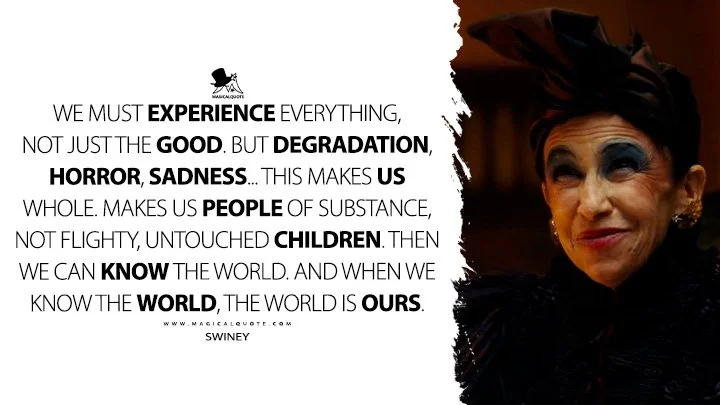
The film is Kafkaesque in the sense that instead of helping Bella to rise up from her sunken state, she has to go even further down to find her way out. What’s interesting and important and difficult for us to understand about the character of Bella is that she embraces her descent with a sense of amusement. For her, difficulties shouldn’t be avoided because they are also opportunities. She views difficulties as the fertile ground on which she can further explore the possibilities of her existence. With this attitude, even time spent in a brothel is informative. Her time there allows her to continue to learn and receive an education that is more empirical, one based on the lived experience of others and her own. She is made to see that sadness and dysfunction make us whole beings, and wanting to be happy all the time is a childish state. Acceptance of suffering, and not avoidance of it, is what leads to the overcoming of it.
Going Back Home
With this understanding, Bella returns home to find out the truth about her origins. She confronts Godwin and in doing so is able to achieve something better than the separation she originally intended. She becomes an individual in her own right, capable of honoring the story she is living and creating about herself, while preserving the parts of her relationship with Godwin that are still important. Her example may be what makes it possible for Godwin to do the same. He is finally able to renounce and break the fantasy bond that he has with his father, and by doing so, is able to be present in his relationship with Bella. He can experience his world with wonder and curiosity instead of trying to control every aspect of it.
For Bella, it wasn’t until she resolved the issues with her father that she was able to establish a mature loving relationship with someone else. One that encompassed union and desire while preserving her freedom and individuality. What I appreciate about the film is that it doesn’t simplify Bella’s bliss. This new loving relationship isn’t an end, but a precursor to her greatest confrontation with the past. The order of these events speaks to the psychological truth that love does heal, but often not until it has brought us face to face with our demons.
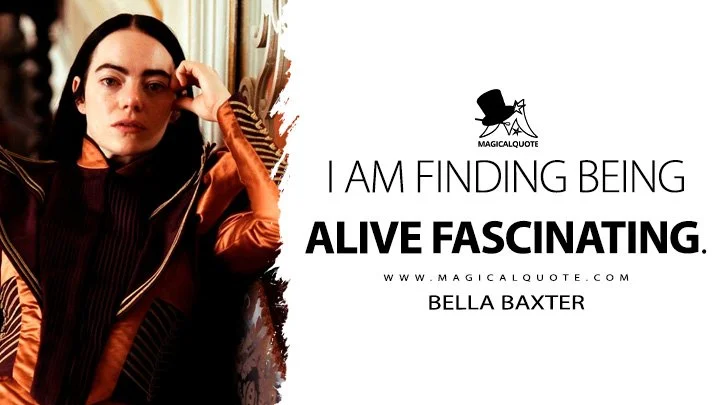
Bella achieves her victory over the past, and most importantly she does so with integrity. She remains curious and hopeful throughout the film. At the end of her journey, having arrived at the place that she is in, she is able to say “I am never happier than when I’m here.” She has made important discoveries along the way about what really brings her happiness, meaning, and purpose.

Identity, Control, and Rebellion: Takeaways from They Cloned Tyrone
Tupac is alive, Michael Jackson ain’t dead, and Toni Morrison might just as well be sitting at a coffee shop nodding, I told you to everyone that passes by. Her presence certainly seems to loom large over They Cloned Tyrone, where you very quickly learn that almost no proclamation is unworthy of consideration, if only for an infinitesimal amount of time.
She, Morrison, articulated the searing effect the white gaze has on black life, giving voice to something that for centuries was a constant, but was so potent and lethal that it was unspeakable. Here it is, recaptured in the film’s opening image of an advertisement with a white man grinning obscenely, overlooking a group of black people having this very debate (about Tupac and Michael Jackson). It sets the stage for the inevitable clash between history and perception, ready to play out in the fictional neighborhood called The Glen.
With art, oftentimes one must at least wonder, if not ask who is the audience, or to put it another way, who did the artist have in mind when they made this? It is assumed, pejoratively, that black movies are made for black audiences and that there is no category called white movies. Movies like Oppenheimer are less impressive to me for the technical feats they accomplish than their ability to craft a historical narrative about post World War II America and what follows that is somehow completely devoid of black people. But alas, it is a movie, made for the movie going audience. Black movies must exist for the supplication of some other category of people.

This particular film (Tyrone) offers commentary on the issue of whether or not things naturally are the way they are, or if they were made to be that way, and swallows up the entire category of living with its questioning. It drops you into the lives of its characters and instead of asking you to wonder why they are like this, which is less of an honest question than it is a silent judgement, it forces you to consider who really stands to benefit from these people’s lives being this way?
Everyone has their own unique response to the question as the answers are revealed. Fontaine (John Boyega), Slick Charles (Jamie Foxx), and Yo-Yo (Teyonah Parris) cycle between moments of doubt, denial, and defiance towards their encroaching reality as they take stock of how complex the machinery of what is happening to them really is.
What it means to have a self, and whether that self is a creation, or the by-product of circumstances is another central theme. Does it even matter, is what the film seems to be asking, because in the end, the self may only be a set of ideas, yours, or mine, made to fit together and promulgated through the body. The trailer and title make it known that clones play a part in the film, in the literal and metaphorical sense. Fontaine discovers he has been cloned, but even before this physical manifestation is shown, the ideas that he embodies appear to be nothing more than the repackaged ideas of someone else, which seems to be true for most of the people surviving in The Glen.
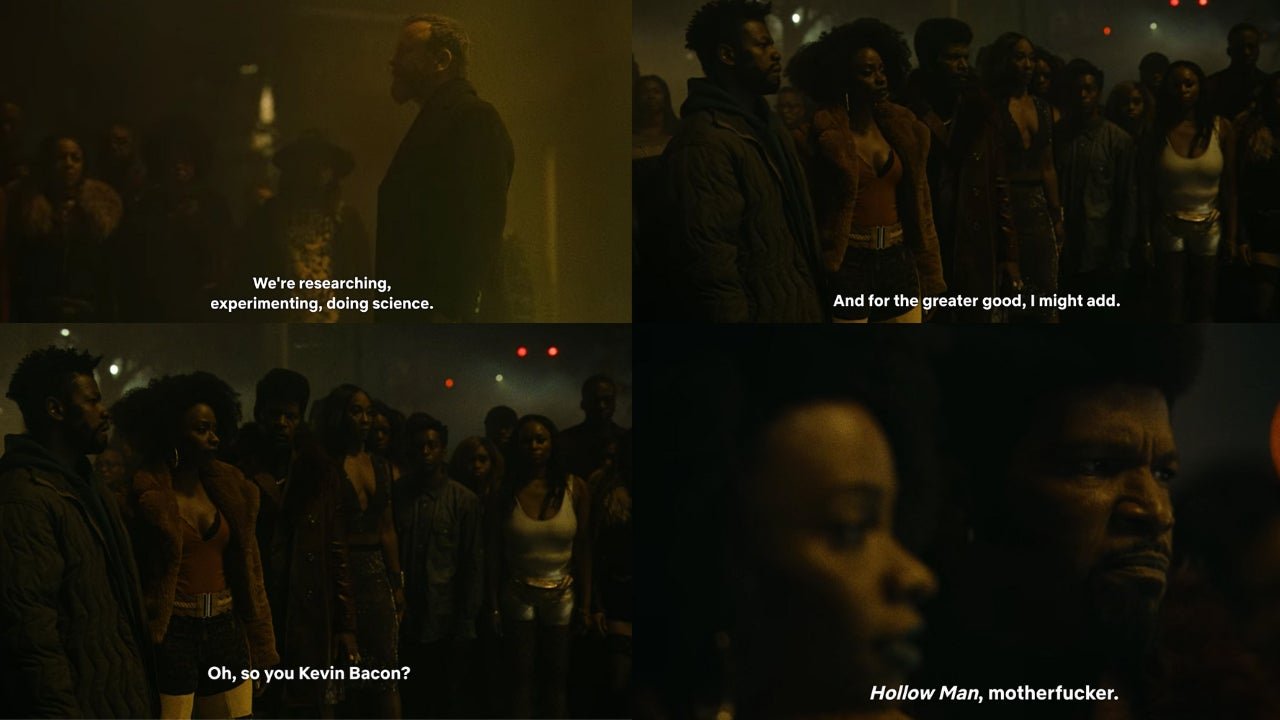
In this way, trauma becomes a common occurrence, and writ large, the private theater of the mind becomes a communal hive. Characters wrestle with what has happened to them and the burden of their nearly forgotten possibilities. Whether one becomes a hero, or a villain seems to hinge on the manner in which they resolve these issues.
Some people never recover from the loss of innocence. One death in particular crystallizes this, but regardless, most characters seem to have had to give birth to an identity much too soon and are thus forced to cling fiercely to it given their vulnerability. Parents are conspicuously absent, and everyone must become their own mother or father much too soon with far too little guidance. Perhaps this is part of the message—parents are, after all, are one step closer to being elders, who function as the collective memory of a community. Memory is a form of safekeeping, without which any group of people is rendered unable to remember the brilliance and tragedy of their history, and thus makes themselves vulnerable to the most wicked ignorance. This is personified by a character whose life is a reminder of what happens when your entire history, past and future, is overshadowed by your worst experience.
The women in the film are the ones who display the courage and intelligence to fight back and injure the cycle that is harming so many, and perhaps break it entirely. They seem to never lose sight of who exactly this is for, and thankfully the film spares them from the fate of being cast as nothing more than accessories to the salvation of men. Yo-Yo dares to dream despite conditions that threaten to suffocate her very existence.
The story is entertaining and even heroic in some moments and fails only if neat and clean resolution is what one seeks, which is certainly forgivable, and fitting given the nature of what it deals with. A quest to discover one’s identity, in this instance, benefits from the inclusion of clones and science fiction but would be no less perplexing without them.

Blonde as Becoming: Frank Ocean and the Time It Takes to Be
On July 10, 2012 Frank Ocean released what would go on to become his critically acclaimed album Channel Orange, subsequently changing his life with its massive success. Excitement about the release of the album was buffered not only by the content, but by the fact that just days before, Ocean released a letter to the public in which he openly talked about his first love being a man. Both the letter and the album were revelatory, and emblematic of Frank Ocean’s style of art, as well as the way he chose to communicate his art.
Frank Ocean’s current predicament is interesting because it highlights the relationship between the artist and their fans. It is a mutually agreed upon relationship in which the artist consents to make and share their art with fans in exchange for what the artist seeks, whether it be fame, fortune, or something else.
A figure as seemingly unique as Frank Ocean is still not immune to the pressures of fame. Indeed, his uniqueness may very well render him more susceptible to the trappings of fame, as society loves to ensnare rarities of all kinds, and observe them on societies terms before moving on to something else. So it comes as no surprise that three years later, many fans and individuals in the music industry seem ready to do just that—they seem ready to quit Frank Ocean after embracing him initially. Months of delayed promises of a new album, with little indication as to when it will arrive will do that to a fan base.
The relationship between Frank Ocean and his fans resembles other relationships in the sense that the qualities that initially attract us— Ocean’s uniqueness and commitment to doing things his own way—begin to repel us as the love bloom fades. Most if not all of that bloom has worn off after three years of waiting. Clearly Frank Ocean is working on his own time, and this is an absolute necessity for any artist deeply engaged in their craft. Rushing the work would produce unsatisfactory results for both Ocean and his fans. It would be a disappointment for Ocean because he will not have remained true to himself, and what becomes of an artist no longer capable of truth? They are no longer capable of art.
Frank Ocean’s current predicament is interesting because it highlights the relationship between the artist and their fans. It is a mutually agreed upon relationship in which the artist consents to make and share their art with fans in exchange for what the artist seeks, whether it be fame, fortune, or something else. Not every relationship is the same, and as a brief comparison, the singer Adele, under somewhat similar circumstances, has not been subjected to the same sort of questioning and heckling by her fans. Adele’s last album was released in 2011, and until October of 2015 she had not released any new music, apart from a song written and performed for a James Bond film in 2012. She had not performed live in three years. Rather than derision, her choices were respected and when she did release new music, it was treated like a godsend. Why has the same amount of patience and respect for privacy not been afforded to Frank Ocean?
The extent to which Frank Ocean’s reputation has changed for the worse, and whether he even cares what others think of him are all unknown at this point. From his previous actions one can surmise that Ocean is more concerned with his creative process than his fame. This is not to say that he does not care about fame at all, and he may even care a great deal about it. What I am saying is that Frank Ocean’s relationship to his art and the process by which he creates that art seem to be paramount, while his relationship to his fans is peripheral. At best, all we can do is guess about what motivations currently guide Frank Ocean, and not fully understanding the intricacies that underlie Ocean’s art because the most we have access to are his albums as finished products, which are not always equal to the sum of their parts. But we should know about the artist as an identity, one that history tells us exists independently of fans who wait patiently or not. Frank Ocean will release his album when he is ready to, and not a day sooner, regardless of those who complain—perhaps he will be better off for doing so.

Eight Shades of Hate: Takeaways from The Hateful Eight
Watching the The Hateful Eight, Quentin Tarantino’s latest film, I found myself arrested by the force with which the story was told. Hateful Eight centers on the relationships between eight people, known for and connected by their prior reputations more than anything else. On its surface, the film is about bounty hunter John Ruth’s mission to complete another successful hunt, but the actual meaning of the film is more complex.
The specter of race looms large in it, and Tarantino addresses the issue by setting the film only a few years after the events of the American Civil War. The ghost of that war hovers over and haunts the characters in the film, and apparently still haunt us today—a recent mass shooting at a church in Charleston, South Carolina testifies to the fact. Making a movie set in the late 1800’s both timely and appropriate. Samuel L. Jackson plays Major Marquis Warren, a decorated army veteran who is now himself a renowned bounty hunter. He is black, and the other characters are indignant over having to deal with his presence. To my mind, Warren represents the coming of a new negro, a phrase later taken up during the Harlem Renaissance which symbolized the kind of black person who outspoken in their refusal to accept the indignities of American society.
The encounter that plays out frightful and electrifying, but first there is a series of half-hearted attempts from the other characters to restrain their hostility towards Warren, mostly owed to his reputation as a man highly capable of killing. Tarantino writes Warren as a character whose intellectual prowess is subtly displayed, skillfully employed, and certainly surpasses his physical skills. This quality is established early on and reinforced throughout the film, not by making Warren appear superhuman, but by highlighting the other character’s failure to recognize him as human at all.
As could be expected from this director given his past proclivity, The Hateful Eight is littered with the N-word. Though it used often, the word feels less out of place in this film than it does in other films like Django Unchained or Pulp Fiction. The historical setting makes the harsh dialogue plausible, and the acting performances mostly make the use of the word believable. Not excusable, then or now, but believable that the N-word would be used by white men as a sort of power grab, to put Major Warren back in his place, and reassure themselves of their own. In similar fashion, the B-word is frequently directed at Daisy, the only prominent female character in the film, which seemed too illicit less powerful reactions from the audience. Why is this so? Why do we cringe at the on-screen use of the N-word but not the B-word, similarly used to dismiss and dehumanize?
Beyond race and gender, The Hateful Eight is a commentary on the overall idea of identity.
Who exactly is Daisy and what does she mean to this film? Of the prominent characters, her story is the most underdeveloped. She is branded as a ruthless criminal, but we do not know to what extent this is true, and in a film where the relativity of truth is an important theme, this lack of explanation cannot be overlooked. Daisy seems to serve as a vessel for the other characters to act out their own pent-up anger towards women. Some of the characters consider her a devil, while others think her life is worth saving, and each character's belief about her fate doubles as a window into their definition of justice. Is it cold and dispassionate, or is it emotionally tinged?
These ideas about justice are also seen through the ways the characters interact with each other. John Ruth is the easy choice for an example of dispassionate justice, but even he falls short of this ideal. They all do, which may be the point—these American made figures cannot possibly live up to their own moral codes, and when it is a choice between them and the other, such codes are easily abandoned.
Beyond race and gender, The Hateful Eight is a commentary on the overall idea of identity. Flashbacks, and well-crafted dialogues highlight the fluidity of identity, and how quickly it can shift. The characters' behaviors, and perceptions of each other, as well as the viewer’s perception of them, changes at a dizzying pace. This pace does not set a new standard for Tarantino films, but in the past, the frenetic pace left some viewers confused, and others dissatisfied, and it is better executed in The Hateful Eight. By confining most of the film to a single room, Tarantino creates a world that is less open and sprawling, while maintaining his style as a filmmaker. The result is a film that operates well on multiple levels, at once being easy enough to follow, and at the same time complex and layered.
Will the audience understand the message? Will they understand that Tarantino is critiquing race relations in America on multiple levels? I fear that the humorous moments laced throughout the film will provide people with enough justification to gloss over the more serious aspects of the work. Especially people who still today harbor the same hateful attitudes as the film’s titular characters. More than anything, with The Hateful Eight, Quentin Tarantino deftly shrinks down a significant piece of the American experiment and places it into one room, serving as a metaphorical melting pot. He captures all the madness that is produced as result of this experiment called America, and the taste of redemption we get when this experiment functions as intended, however short and fleeting those moments may be.

Why You Don’t Want Your Ex to Date Anyone Else
Even in a long gone by now golden age of men who were dandies that proudly laid out their affections as well as their fleeces, and women who moved with gilded elegance, the idea that we meet the one and fall in love has been a pervasive myth. It does sometimes happen to be the case, that the first love is an enduring one. But for most people their endurance is tested in terms of how much disappointment, and consequently, how much pain they can bear throughout the course of several romantic relationships. It is not unusual that some romantic relationships end, and there are good reasons that we should want them to. What is unusual is that even when a relationship does end, and even when we no longer love a person, we sometimes refuse to accept the idea that our former beloved will go on to care for and eventually love someone else.
It feels good to be thought of and remembered by the ones we love, but it feels better to be remembered by the ones we don’t.
We harbor the wish that our exes continue to see us in a certain light. We want them to think of their time with us as a unique and singular experience that irrevocably changed them for the better. It is oddly gratifying to know that they are forlorn without us, but this wish only reveals something about our own state of mind. When a relationship ends, even one whose demise we welcome, both people enter a state of loneliness. In this painful space of separateness, we find ourselves yearning for our former foundation. Yes, there was rot, and it was filled with cracks, but it still provided something. When we diverge from the path of coupledom, we find ourselves not knowing what comes next. The feeling of being lost is what we are trying to avoid when we cling to our exes in one form or another.
We maintain a connection to an ex by trying to transform the romantic relationship into a friendship. An effort that usually fails because we have not given ourselves enough time and space to make sense of what happened and sort ourselves out. But in another sense, it “works” because sorting out and sense-making is the last thing a person wants to do when they are reeling from the pain of a breakup.
And even when we choose to expel a former lover from our life, we still want that person to think well of us. We want to feel special in their eyes even when they long ago lost the ability to spark the same reaction in ours. It feels good to be thought of and remembered by the ones we love, but it feels better to be remembered by the ones we don’t. It makes us feel especially unique and powerful. That I could reject a person and they could still hold me in the highest regard and still want me.
It makes sense that people are dismayed when they find out their ex has a new romantic interest. They’re moving on, and if an ex is moving on then maybe we aren’t so important after all. Maybe we never were. Those kinds of thoughts are felt more than they are formulated, and they produce an aching sensation. Of course, we can’t avoid them forever, neither by turning towards the past we had with our ex or leaping into the arms of someone else without taking time for self-reflection. You can acknowledge the pain of having your ego bruised, by the mere thought of your ex caring for someone else as much as they once cared about you and accept that in all likelihood that is exactly what will happen. Their role in your story is finished for now, or forever, and all that any of us can do about it is get back to the relationship we are always in, which is with ourselves, and slowly start to rebuild.

Can Psychotherapists be Seen as Artists?
When approached and practiced in certain ways, psychotherapy can be elevated to the level of an art form. The fact that psychotherapy is still (and necessarily so) a private affair that is hidden from public consumption makes it more difficult to qualify or quantify its status as a form of art. But for the many who practice it and the few who get to observe it, there are differences between straightforward practitioners and artists in the trade.
Consider this—art is a realm of subjectivity, where often times consensus is king and the majority rules. The paintings of a Da Vinci and Picasso, or the designs of Frank Lloyd Wright still leave some cold. As do the writings of Baldwin, Morrison, or Rowling. But to a sizeable amount of people, their works represent titanic triumphs of human creativity. Whatever this sizeable number is, it represents mass approval, which is so often necessary for the triumph of art over obscurity, but of course a number is not all that art is. And this mass effect I speak of has lent its weight not only to the crafts of painting, architecture, or literature, but also to psychology, the study of the human mind.
To be clear, mass approval is not enough. The popularity of a thing does not mean that it is worthy of adulation. Art stirs something deep inside of us and brings it to the surface. Art disturbs, and is confrontational at times, but it also seeks pathways to deeper connection with oneself and with the world. The beauty of art lies in the way it makes us feel something that is deeply personal and at the same time relatable to all of humanity. How the artist achieves this effect differs based on their tools and the talents they possess, but the desired effect is always the same. To wake others up to themselves and get them to feel deeply.
The psychotherapist does not use the brush of the painter, the instrument of the musician, or the charts, graphs, and measuring tools of the scientist. They use themselves—their presence, consisting of their body, heart, mind, and spirit, which allows them to forge an alliance with those they work with in hopes of bringing forth something new. The artist plays at God as they attempt to corral creation, and in a sense the psychotherapist does the same. The best are very intentional about their ambition.
At times the psychotherapists will fail: there will be clients who do not change or become better, and some who may become worse. To fail in the endeavor to create and bring forth something new in a person can be more devastating than errant brush strokes and misplaced musical notes. This is because a person expresses consciousness rather than simply being a product of consciousness. To work with another, knowing their potential and their limitations, and journey through the maze of their life with them takes courage and trust. Trust, in another and in oneself, is the bedrock on which creation takes place. Without it there is no sense of direction, no willingness to take risks, and no progress which can be made.
It takes courage and a certain audacity to practice art, because it requires a willingness to exist separate and apart from others. A distance that is necessary when one does not simply want to talk, but feels they truly have something to say. Whether or not the feeling is justified is a bargain which must be struck between the individual and society. Some psychotherapists have much to say about nothing. They regurgitate empty platitudes or vomit up their own insecurities, inappropriately praising themselves or judging others without having earned a right to do either. They move at a frenetic pace while accomplishing little of substance; they retreat into data and evidence whenever they are confused or unsure, signaling that they do not know how to practice the art of psychotherapy, but only how to follow the manual they were taught.
The client who comes before the psychotherapist may for the first time in their lives, as a result of their dissatisfaction, be open minded enough to have a real encounter with themselves. The approach of the typical psychotherapist is management and symptom reduction—to be able to give a pat on the back to the client as they walk out the door and assure them that they are okay without ever asking them to be better. The artist who practices psychotherapy seeks other things—connection, engagement, growth, and transformation in ways that are organic and unique to the individual they are working with at the time. Only art can do this. At its core the musician has there 12 notes to achieve this, the writer has there 26 letters, and the psychotherapist has their self. More than any theoretical background, use of the self is needed, a self that accepts life with its tensions and challenges, and helps others do the same.

What is the Purpose of Psychotherapy?
To tolerate life remains, after all, the first duty of all living beings. Illusion becomes valueless if it makes this harder for us.
— Sigmund Freud
The psychotherapist is always listening. They listen to the stories people tell them; stories that double as half-truths they simultaneously tell themselves. Stories that the therapist may tell themselves just as often. Listening comes with the territory, and part of what makes someone a good therapist is the ability to do so. To an outside observer it might not look like much is going on between a client and a therapist. Just two people having a conversation, but beyond initial appearances, a complicated exchange is playing out between the client and the therapist.
In a therapeutic dialogue both client and therapist are constantly testing one another, and constantly testing themselves. The client wants to know if someone the therapist, purported to be a professional helper, is really up to the task, which is a fair question because therapist do not always know. More than that, the therapist is not always sure of the client’s commitment either, and there is enough uncertainty and trepidation to make one ask, what is the purpose of all this psychological probing and is there an end goal to be reached once it’s all done?
It’s certainly a fact that people test one another, in therapy and in life, to find out whether or not it is safe enough, physically and psychologically, for them to be honest about who they truly are. and few situations engender this more than the unfamiliarity of finding oneself for the first time sitting on in a therapist’s office with the expectation that you simply open your mouth and start to share your thoughts and feelings with someone you just met. In order for anyone to do this, the therapist has to quickly convince the client of their skill and capability. Without this initial convincing, there is no reason for the client to be there, and their presence will certainly be short-lived. With it, the client feels safe enough for the work to begin.
What the client gains is a place to retreat from life when they need to. A place where they can get enough distance from the world to start learning about it—if you live long enough you know that it is difficult to be curious when you are being assailed on all sides by challenges, at which point surviving life’s harsh realities becomes the main goal, the only goal, and the lens through which all other choices are filtered. Therapists are there, one hour at a time, to pull the client out of their world, and more importantly, to pull out the parts of the client’s world that they struggle with the most. To push the client to confront the parts of life they are most confounded by.
It is only through facing the things in life that are most difficult and confusing that people begin to make sense of them. It is a process that must be repeated numerous times throughout their lives because new challenges require new answers regarding how they will be met and eventually overcome. In the end, there simply is no cure for life.
The psychotherapist acts, for some length of time, as a secular guide on the client’s journey, helping them learn how to confront their deepest anxieties and overcome their most stressful life events. Helping clients to become more skilled in the art of living is the psychotherapist’s purpose, and in carrying it out, clients themselves begin to develop their own, one that is not based on unearned confidence, but is carefully arrived at, with the proper motivation to pursue it.

On George Floyd & the Trial
Today marks the beginning of what will likely become another notorious case in American history; the trial of Derek Chauvin, the man accused of murdering George Floyd. The jury selection will begin tomorrow and from there the trial will proceed towards its unsavory end, on display for the entire country to see. The outcome of the trial will serve as a litmus test as to whether the events of the last year, and years before that, have altered the mind of the American republic enough to deliver a more just decision now. It will carry with it the weight of the question, what is the American attitude towards those who wield power dangerously?
A society that produces encounters where innocent citizens can be murdered for no good reason and families can be left without any earthly retribution is a society that must rethink itself.
Incredulous at it seems, a question that inevitably will be asked is whether or not Chauvin caused the death of Floyd. Conviction for the charge of second-degree murder which Chauvin faces hinges on the answer to this question. There will be now, as there were then, voices that proclaim Chauvin’s innocence and those that contest it, hence the need for a fair and judicious legal process. However, if one looks at and considers the thresholds that must be met for conviction, it is clear that Chauvin blasted through them. Second-degree murder entails causing someone’s death while committing third-degree assault, which is defined as the reckless infliction of the fear of serious bodily injury, or recklessly causing a fear of injury through the use of a deadly weapon. Recordings of the incident made it so that the use of imagination was not required to conjure up the sights and sounds of Floyd on the ground trapped underneath the force of Chauvin. The fear of Floyd was plainly visible.
Chauvin was negligent by any definition of the word, whether judged by the typical standard applied to an everyday citizen of this country, or the greater standard applied to those in positions of power and privilege, as was the case for Officer Chauvin. It seems that this principle, that those with greater power and freedom must willingly resign themselves to greater responsibility, works in reverse in many instances in America. Instead those with the most power operate with reckless impunity, housed inside of a psychological funhouse where every image they see is a powerful distortion of themselves and others which they unquestionably believe. The least of us suffer for these illusions.
The crimes committed without consequence by Chauvin and the like, whose chief concern should be upholding the law, range from the mundane to the murderous. One thinks of Jeronimo Yanez, the officer who murdered Philando Castile in 2016, who was acquitted of any and all charges and received a buyout from his police department. Or Timothy Loehmann, the officer who murdered twelve year old Tamir Rice in 2014, and was also acquitted of any and all charges. I do not know Yanez or Loehmann, just as I do not know Castile or Rice, but a society that produces encounters where innocent citizens can be murdered for no good reason and families can be left without any earthly retribution is a society that must rethink itself. It must reconsider its entire way of doing business and ask what exactly is its chief business—is it the perpetuation of the free market, the importation of democracy, or some other lofty ideal? Perhaps it should settle for the protection of its citizenry.
The second question to be answered is whether or not Chauvin’s actions were reasonable. Again, looking honestly at that term we can only answer negatively. Reasonable implies fairness, sensibility, moderation, and nothing of the like was contained in the actions of Chauvin. The acts of kneeling on a man's neck for nine minutes while ignoring his pleas for relief, his crying out for his mother, and even the sensation of his body giving up on itself as he went limp do not function within the realm of reason. These are the actions one reads about in books outlining the barbarism of past days and witnesses in films of the Tarantino type, with violence at times so hyperbolic it becomes a caricature of itself.
George Floyd may have had drugs in his system at the time of his death, and this is being trotted out as an actual cause of death instead of the actions of Chauvin, and being used to defame Floyd. But what is the likelihood that Floyd, even in an intoxicated state would have rapidly declined and spontaneously succumbed to his condition without the intervention of Chauvin? The assertion seems ludicrous, as does the assertion that the officer was so fearful of the threat that Floyd posed that he had no other choice but to react the way he did. I am aware of several pieces of anecdotal evidence of black people behaving drunkenly and belligerently and living to tell the tale. I am unaware of any anecdotes about white people behaving in the same way and not living through it, and that is what troubles the conscience.
Questions that should be raised and debated, especially in the medical field and other related fields, is how do we treat the chemically intoxicated in this country? How should we treat them? Should a person’s being sufficiently intoxicated, or even insufferably intoxicated essentially become a license to do grave bodily harm to them, or even a license to kill? There exists in my mind an easy answer to the question, which is no, intoxication should not be met with excessive force, but how to clarify what that means and how to not merely teach, but actually infuse that ethos into our way of thinking is not something I can pretend to know for now.
In the meantime, consider the kinds of things the thousands who organized and protested over the last year will want to know—such as why it seems an accepted norm in this country for police officers to violate citizens' constitutional right to life and get away with it? There are laws in this country that are sacred when one considers the fact that the ink with which they were written is doused with the blood of countless martyrs to the cause of freedom and liberty. No one should be able to trample on those rights easily.
Chauvin’s case will test the resolve of the American legal system’s beliefs. I am not at all interested in the question of whether or not the American legal system has the power to punish—it is clear that it does. I am interested in whether or not this system will continue to err on the side of protecting those, who through their own actions, do not warrant the level of protection they receive. This question is not purely rhetorical or theoretical; it is an urgent issue, and the answer must be worked out to perfection. Another instance of acquittal on all charges would be a disaster, proving once again the presence of a body politic that is chiefly concerned with the preservation of power for the few who wield it at the expense of the many who do not.
What the Four Givens of Existence can Teach Us About Mental Health
The architects of Existentialism did not succumb to the idea of human beings existing as the center point of the universe, with dominion above and beyond all else. Nor did they conceive of humans as being in a state of perpetual progress that was preordained and inevitable. Man is neither a being made in the image of God, with its implied superiority in comparison to all others nor is man destined for greatness in any field. Humankind is in all likelihood the result of an evolutionary process that if not completely random, is certainly a dispassionate one that curries no favor for any one particular group.
Rather than take a medical perspective, one can consider the issue from a philosophical perspective, which is what Existentialism aims to do. Life is a series of ongoing exchanges of meaning and profundity with human beings serving as the transmitters of these messages, but amidst the rabble there exists certain limitations. Humankind as it is constituted in the past, present, or future is never an inevitability, but certain conditions of life are constituted as such and exist outside of time. Irvin Yalom has dealt with and written about And then some a morning these conditions, calling them the givens of existence; I will restate and reappraise them here.
These givens of existence are matters of ultimate concern for human beings and in many ways affect how we choose to live our lives. Freedom is the first given, and I speak about it in terms that extend beyond an individual’s ability to act out their wishes. Freedom refers to a lack of solidity in all of the structures that human beings create and are thrown into. Lack of structure points to a world without external laws or moral codes to govern our behavior and dictate to us how we should think, feel, and behave. Every system is constructed, and consequently is untenable in the final calculation. The very laws that govern the universe have been revealed to be open to clarification and re-interpretation as the scientific process continues on.
Recognizing the groundlessness of existence turns out to be a dizzying experience rather than one that brings relief. To understand that there are no external rules that govern life and that the rules one follows are arbitrary is to acknowledge that one is free to choose whether or not to continue to follow those rules. The consequences of either choice fall squarely on the shoulders of each man or woman and cannot be handed over to fate or social forces, however large a shadow they cast. Stress and anxiety often accompany this realization, and maladaptive behaviors can arise in an attempt to cope.
One also deals with isolation as a given of existence, not in the sense of being lonely without the company of others or having to endure punishments such as exile or solitary confinement. Existential isolation cuts to the core of what it means to be isolated; no matter how close we get to others there is still a final unbridgeable gap that we can never close. No matter how badly we want to know and understand someone, and despite all the energy and effort we may devote to this endeavor, we can never get at the heart of another human being. Worse than that, we cannot fully understand ourselves, and if we fail at this then we cannot help but fail at the task of understanding the other. We seek merger with someone or something greater than ourselves as a means of achieving wholeness, but we shrink from this same merger out of fear of being overwhelmed and obliterated by the other. Successfully relating to others is a process of continuously finding healthy ways to balance this tension.
Though life is a process of becoming it is also a process of unbecoming and death is the biggest step in the latter process. Death is something that every individual must contend with and as such is an obvious given of existence. Every single person who lives will one day cease to be in a physical sense and eventually in a psychological sense as well. The difficulty is not the end result, but in knowing what one would rather not know, and having to find a way to live with a force that is indifferent to us, that for centuries we have imbued with layer upon layer of meaning.
Each of these givens of existence build upon and inform the final given which is meaninglessness. Because there are no external structures that exist outside of time or human invention and because humans are capable of and free to constitute the world in numerous ways, there can be no inherent meaning which applies to everyone in the same way. Tension lies in the fact that human beings are creatures obsessed with making meaning out of their experiences. We derive meanings where there are none and create them if we have to and this is a task we take up repeatedly throughout our lives as a way of making sense of things so that we can live effectively.
It is important to approach these givens of existence carefully, absorbing and understanding them slowly, little by little until one is strong enough to bear the burden of these conditions. They are each in their own right difficult to comprehend, and doing so can lead to radical shifts in the way one engages with life. But understanding one’s terrain is much more useful than having no real grasp of the lay of the land.

Why I Am an Existential Therapist
Life, it seems to me, lends itself to certain possibilities. Possibilities which themselves take on an air of inevitability - that perceptive persistent state in which choice and free will are at first subsumed and at last obliterated. I was born and just as quickly as I began to bloom I also began to be pruned and peppered for ends neither freely chosen nor wholly my own, if at all, barreling towards them until I would finally reach some unsatisfying conclusion.
Having arrived, and realizing how little of my life was of my own choosing, I started to examine the whole affair in order to understand where I was, and if necessary to uproot myself. Some things have been said about what it feels like, this unshackling, this untethering, but very little about how frightening and arduous a task it is to really do it; to really choose for yourself. At times you wonder if you've gone crazy, a word I am less and less convinced describes anything substantial, least of all what one is actually going through. But if empty words are the cost of breaking with some old way of life that is ordered but agonizingly dull and predictable, then so be it.
I’m told I was born without a heartbeat or a pulse, by way of unforeseen complications during my mother’s pregnancy. That the first thing to wrap itself around me was not a warm blanket given by some nurse or orderly reeling from a night of dealing with birth and death and all of the excrements of life, and it was not the weary arms of my mother. Death covered me, prematurely yes, but it covered me all the same. I assume I lay quiet and breathless as seconds stretched into the ether, serving out a death sentence that at best would be reduced to a charge of brain damage and a lifetime of silent “if onlys.” I’d be incredulous if I had not seen faded pictures of the whole ordeal pressed into the yellowed pages of my family’s photo albums, themselves remnants of the past.
Somehow, I survived all of that, and the irreversible damage that was predicted never did set in. Eventually my lungs filled with the sweetness of air as I began to breathe, my heart started to beat, the cascading wires attached to my body were removed, and I was not plucked away too soon. This story has always stayed with me.

As a child I wondered if I was special for surviving: I wanted to believe it, though I truly did nothing to accomplish the feat. My body wanted to live so it did; the rest is a mystery to me. Perhaps others knew it better and could explain it best back then, but all of those faces and most of those memories are lost now. More meaningful than the mystery or the facts involved was how the experience affected me, by which I mean it provided me with an early sense of my situation, which gradually grew into an awareness of the situation for us all. I was alive, but this did not have to be the case; it was not a guarantee, or a promise, or the fulfillment of some far off prophecy; it was the outcome of incalculable events, more innumerable than I could begin to understand.
Awareness being no guarantor of anything, least of all progress or change; I was not well equipped to deal with the conditions of my life that at times practically begged to be faced, and I was not well equipped precisely because no language that is given and not freely chosen can contain within it the power a man or woman needs to work out life’s problems in their own way. So I began, earnestly, to find my way through the use of philosophy and the deep introspection that accompanies it, and ultimately through existentialism, a philosophy dealing with freedom, authenticity, meaning, and even the inevitability of death, the ultimate human concerns. It did not ask me to shrink in the face of my responsibilities or to abdicate them to some force outside myself, but to accept them as my own, and more strangely than that, to accept myself as my own and value myself accordingly. It readied me for the challenge of trying to find answers to the questions about life that have perplexed humans for as long as our ancestors have walked under the warmth of African suns. It allowed me to meet, on neutral terms, the pervasive loneliness that ached inside of me and was reflected back in the eyes of the men and women in my community. It heightened my senses, and at the risk of romanticizing, brought to life, for the first time in a long time, a necessary intensity, an urgency to live while I can. It opened me up to the world and all the beauty and terror that lie therein.
My interest in existentialism paired with my choice to become a clinical social worker led me to existential psychotherapy - a dynamic method of therapy that was created out of the core principles of existential philosophy and fashioned to meet the needs of clients suffering with mental disorders. It provided a framework that aligned with me personally and professionally and connected me to a lived tradition that includes clinicians, writers, philosophers, activists, artists, and more.
I choose to work existentially because those same aches and pains that have plagued me have plagued us all. Because for the deeper problems of life there is no manualized method or simple solution that will banish from our sight for forever and ever, the pain and confusion and awe of living. We each must contend with our fair share of struggle and strife as we try to meet life on its own terms, and try we must, since the only way out is through (I’ve yet to find another). If somehow, in trying, I can sit with others compassionately, and bear witness to the fineness and the folly of the journey each human must undertake, then perhaps some growth and healing can be had for us all.